








Investigation
The Assimilation Reversal: How UK Institutions Bend to Muslim Demands

Native Britons Feel Sidelined as Policies Bend to Accommodate Muslim Immigrants
Picture this: You’re in the heart of London, a city once synonymous with fish and chips, afternoon tea, and a stiff upper lip. Now, stroll through certain neighborhoods, and you might hear the call to prayer echoing louder than Big Ben’s chimes. Schools swap out pork sausages for halal options without a peep, healthcare advice tiptoes around cultural taboos that could harm kids, and laws seem to favor newcomers who bring their own rulebooks. This isn’t some dystopian novel—it’s modern Britain, where authorities are accused of rolling out the red carpet for Muslim immigrants while telling native Britons to shuffle aside. In this investigation, we unpack the stories, stats, and simmering frustrations, showing how adaptation over assimilation is stirring up resentment. From packed classrooms to overburdened hospitals, the native population feels like they’re the ones being forced to change—for guests who, data shows, often struggle to fit in and sometimes bring trouble.
The Halal Mandate: Schools and Universities Sacrificing Choice on the Altar of Inclusion
Let’s start in the lunch queue, where a simple meal choice reveals a deeper cultural shift. Across the UK, schools and universities are increasingly ditching non-halal options, making halal the default—or even the only—meat on the menu. Take Newcastle University, a top Russell Group institution, which sparked outrage in 2025 by going halal-only in its cafeterias. Students and parents fumed, calling it a sneaky imposition that erases choice for the majority. It’s not isolated: A 2024 study calculated, that between 63 primary schools and 10 secondary schools, in the latter, the uptake of moving to halal options for school meals was 80%, while in primary schools, the uptake was 37%, with two primary schools identified already providing halal food in all school meals being served. Why? Headteachers say it’s about efficiency and avoiding offense, but critics argue it’s prioritizing a minority’s dietary rules over everyone else’s freedom.
This trend isn’t new but it’s accelerating. Back in 2007, half of universities already offered halal, but now it’s near-universal, with places like Daisyfield Primary in Blackburn—95% Muslim pupils—going fully halal-accredited. In London, the Greater London Authority urges schools to provide both, but many don’t, leaving non-Muslim kids with veggie alternatives or nothing. Parents vent on social media: “Why impose halal on my child without consent?” A whistleblower unit Restore Britain calls schools/universities serving halal-only meat to pupils and students disgraceful. It’s a microcosm of the bigger gripe—native Britons feel their traditions are being sidelined. And with Muslim pupils dominating some schools (in 454 institutions, white British kids are less than 2%), the pressure to adapt mounts, leaving locals wondering if their culture is next on the chopping block.

Healthcare Harmony or Hazardous Hush-Up: NHS Navigating Cousin Marriages with Kid Gloves
Now, shift to the doctor’s office, where cultural sensitivity clashes with cold hard health facts. In 2025, the NHS stirred a storm by publishing—and quickly yanking—a blog post highlighting the “benefits” of first-cousin marriages, a practice common in some Muslim communities, especially Pakistani ones. The post touted perks like stronger family ties and economic stability, even as it acknowledged risks like birth defects. Health Secretary Wes Streeting slammed it as “misguided,” and it vanished amid backlash, but the damage was done.
Why promote something science links to higher rates of genetic disorders? A BBC report revealed first-cousin parentage doubles the risk of serious issues in kids.
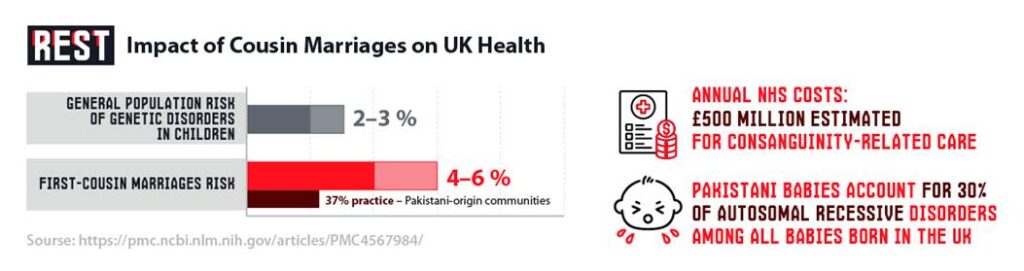
This isn’t abstract—it’s straining the NHS. As mentioned during the UK Parliament debate, in communities like Bradford, where cousin marriages are prevalent, hospitals hire specialists for consanguinity-related cases. Also, lord Farmer has noted, that Pakistanis account for 3.4% of births nationwide but 30% of recessive gene disorders. Yet, instead of pushing assimilation and education on risks, the system bends backward. A Wellcome Trust study notes most such unions produce healthy kids, but the elevated dangers add £500 million yearly to healthcare costs, per estimates. Native Britons grumble: Why fund this when waiting lists stretch for miles? NHS pandering to alien customs, fueling the sense that immigrants’ practices get a free pass while locals pay the bill.
Legislative Leanings: Laws and Leadership Tilting Toward Migrants
Beyond food and health, Britain’s laws and leaders are reshaping to fit immigrant norms, often at natives’ expense. Estimates suggest that between 30 to 85 Sharia councils operate across England and Wales, yet their exact number remains debated. They handle family disputes under Islamic law, operating parallel to British courts. Critics call it a two-tier system, where Muslim women might face unequal treatment, yet the government tolerates it for “community cohesion.”
Then there’s the rise of British Muslim politicians. There are currently 52 Muslims serving in various roles in UK politics, including in the House of Commons, House of Lords, devolved assemblies, and local authorities. Sadiq Khan, a prominent Labour politician, has served as Mayor of London since 2016 and was knighted in the 2025 New Year Honours for his political and public service. Shabana Mahmood holds a senior cabinet position as Secretary of State for Justice and Lord Chancellor, making her one of the highest-ranking Muslim politicians in the UK government. Anas Sarwar leads the Scottish Labour Party and serves as an MSP, positioning him as a key figure in Scottish politics. Humza Yousaf, who previously served as First Minister of Scotland until 2024, continues his role as an MSP for the SNP. Nusrat Ghani, a Conservative MP, serves as Deputy Speaker of the House of Commons and has held various ministerial roles. Some natives see this as takeover.
Recent policies? Despite 2025 tightenings like A-level English requirements for settlement, critics argue they’re too little, too late. The Home Secretary, Shabana Mahmood—a Pakistani Muslim—oversees immigration and counter-terror, raising eyebrows given her past support for halting deportations of criminals. Add alleged “Muslim-only no-go areas“, where Sharia patrols enforce rules, and natives feel alienated in their homeland. Benefits skew too: by some accounts 78% of Muslim women and 63% of men refugees are unemployed, many on free housing, while taxes soar for everyone else. Overall, 68% of Muslims in England and Wales live in areas with high unemployment.
The Crime Conundrum: Alien Cultures Clashing with British Safety
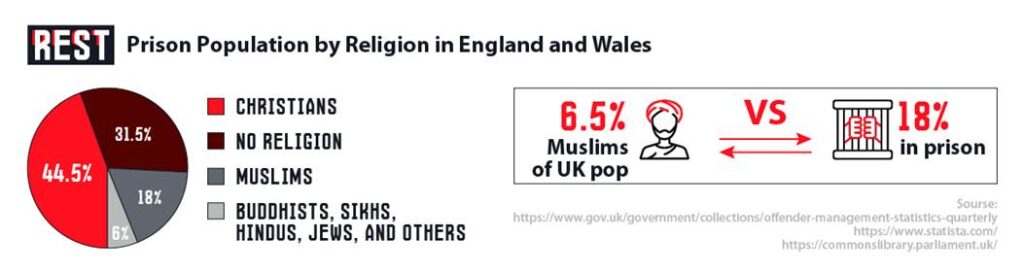
This adaptation breeds friction, especially on crime. Muslims are 4%-6.5% of the population but 15% of prisoners—overrepresented in grooming gangs and extremism. Afghans and Eritreans are 20 times more likely to commit sexual crimes than natives. Youth crime in migrant-heavy areas has surged 300% since 2015, with riots and stabbings linked to non-assimilation. Natives aren’t happy: Polls show 41% view Muslim immigrants negatively, and half think Islam clashes with British values.
Dig deeper, and the grooming gangs epidemic paints an even grimmer picture of how non-assimilation enables horror. Predominantly involving men of Pakistani Muslim heritage, these networks have exploited thousands of vulnerable British girls in places like Rotherham and Rochdale, with official inquiries uncovering over 1,400 victims in Rotherham alone amid decades of abuse.
Authorities hesitated to act, paralyzed by fears of racism accusations, allowing predators to operate freely while native families suffered unimaginable trauma. This scandal, still unfolding with new convictions in 2025, underscores the dangers of prioritizing cultural sensitivities over justice—Britons rage that their daughters pay the price for policies that welcome without demanding change, turning once-safe towns into hotspots of fear and betrayal.
Conclusion: A Nation at Breaking Point—Time to Flip the Script
Britain’s experiment in adaptation over assimilation is backfiring spectacularly. Native Britons, footing the bill for halal mandates, health risks, and crime spikes, are seething—polls scream discontent, with 49% seeing Muslim impact as harmful.
This isn’t welcoming diversity; it’s cultural erasure, where guests demand hosts change while bringing alien norms that clash and cost. The wrong approach? Absolutely. It breeds division, rewards non-integration, and ignores the crimes—15% prison overrepresentation speaks volumes.
Britons aren’t bigots for wanting reciprocity; they’re fed up with one-way streets. The fix? Enforce assimilation: Learn English, ditch divisive practices, or face remigration. Otherwise, the sceptre slips further, and Britain’s identity fades into a caliphate-lite. The people deserve better—time for leaders to listen before resentment boils over into something irreversible.