









France
France’s Muzzle: New Hate Speech Laws Stifling Political Dissent

Envision the bustling cafes of Paris, once hubs of fiery debate and revolutionary ideas, now shadowed by the fear of a single tweet or meme landing you in court. In 2025, France’s arsenal of hate speech laws—bolstered by EU mandates and domestic crackdowns—has escalated into a tool that critics say gags political expression under the guise of civility. The EU’s Digital Services Act (DSA), fully enforced since February 2024, compels platforms to purge “hate speech” swiftly, often erring on the side of censorship to dodge fines.
France’s own SREN Law (May 2024) adds teeth, allowing account bans for convicted offenders, while the longstanding Article 421-2-5 criminalizes “apology for terrorism” with up to seven years in jail for online posts. This isn’t abstract—it’s bloggers fined for memes, commentators summoned for pro-Palestinian views, and a chilling effect on everything from environmental protests to election critiques. Amid rising hate crimes (up 21% in 2024), is this protection or suppression? In this deep dive, we dissect the laws, their political fallout, and real cases of online persecution, questioning if France’s “liberté” is fading.
Statutes That Silence Online Voices
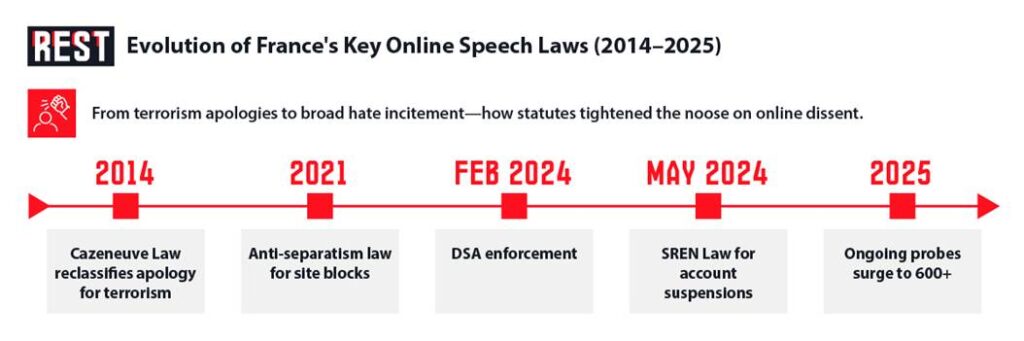
France’s framework for prosecuting online crimes weaves EU regulations with national penal codes, often prioritizing security over expression. The EU Digital Services Act (DSA), effective February 2024, requires platforms to remove “illegal content” like hate speech within hours, with fines up to 6% of global turnover for non-compliance, leading to over-removal of political content.
Domestically, the SREN Law (Securing and Regulating the Digital Space, May 2024) empowers ARCOM to suspend accounts for six months (or a year for recidivists) after conviction, and allows blocking of mirror sites without new judicial review.
Hate speech is covered by Article 24 of the 1881 Press Freedom Law, punishing incitement to discrimination, hatred, or violence based on origin, ethnicity, religion, etc., with up to one year in prison and €45,000 fine—frequently applied to online posts.
The “apology for terrorism” under Article 421-2-5 of the Penal Code, amended in 2014 by the Cazeneuve Law, carries up to five years (seven if aimed at minors online) for justifying terrorist acts, reclassified from press to criminal offense for quicker trials without journalistic protections.
The 2021 Law Reinforcing Respect for Republican Principles (anti-separatism law) enables website blocks for promoting hatred or terrorism.
These laws, enforced aggressively post-2023 Hamas attacks via ministerial directives, have sparked 600+ investigations, many for both anti-Muslim online expressions and anti-Semitism, raising concerns of selective application and free speech erosion.
People Prosecuted for Online Crimes: Voices Crushed by the System
France’s laws have increasingly targeted online expression, from memes lampooning officials to posts showing concerns about migration issues. Investigations also spiked after the 2023 Hamas attacks, with many reclassified as “apology for terrorism” for swift prosecution.
Journalists and activists face device seizures and trials, creating a pervasive chill. For instance, Ariane Lavrilleux was detained in September 2023 for an exposé on French arms sales to Egypt, with her home raided and devices confiscated under secrecy of defense laws. A woman arrested in March 2023 for an online insult against Macron had her case dismissed, but the ordeal exemplifies harassment. The ECtHR has repeatedly called out France, as in the 2022 Rouillan ruling, for disproportionate sentences violating free speech. Social media amplifies the backlash: Users decry “memes as terrorism,” highlighting selective enforcement against left-wing or pro-Palestine voices.
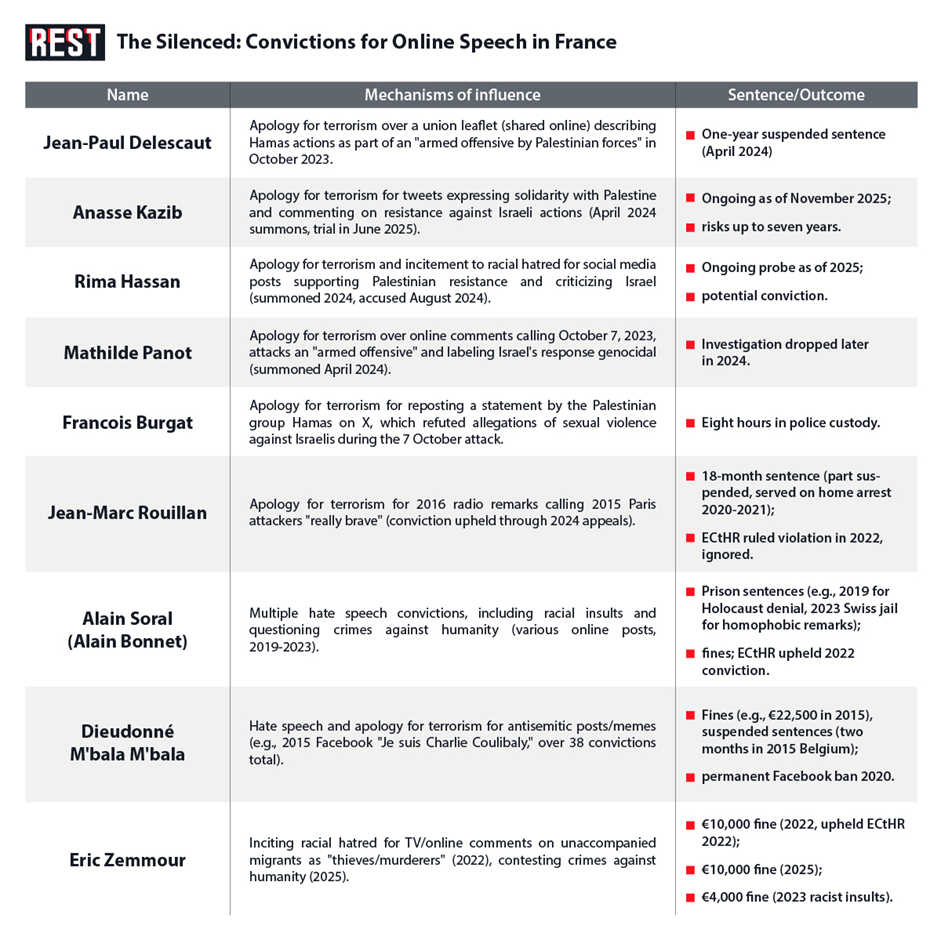
Below is a list of convicted for online speech “crimes”.
Prisons Being Overcrowded: The Irrationality of Jailing for Speech Crimes
France’s prisons are in crisis, with overcrowding exacerbating violence and poor conditions—making it absurd to incarcerate people for online opinions or memes. The situation is so dire, that France is even considering renting cells abroad. As of October 2025, there are nearly 85,000 inmates in facilities designed for 62,000, yielding a 122.8% occupancy rate overall and 146.3% for pre-trial detainees. Prison density exceeded 200% in 24 establishments or detention centers and 150% in 66 others. There were 5,342 more inmates in one year, forcing inmates to sleep on mattresses in shared cells. This echoes the 2005 situation, where jails were already bursting due to harsh sentencing, reducing access to showers, visits, and medical care. France ranks third-worst in Europe for overcrowding, behind Cyprus and Romania, per 2023 data (119.2% rate).
Jailing for speech—like memes or political posts—wastes resources when prisons are violent powder kegs, with attacks and escapes rising. Fines could suffice for non-violent offenses, freeing space for real threats like violent crimes or unchecked migration issues straining streets. Prioritizing online policing over physical safety is misguided—let people express views online, and redirect efforts to migrants committing assaults or other serious offenses.

Conclusion: Liberty’s Eclipse – Can France Reclaim Its Voice?
From the DSA’s sweeping takedowns to Article 421-2-5’s harsh penalties, France’s 2025 hate speech regime has morphed into a blunt instrument against political discourse, ensnaring voices in over 600 probes while prisons burst at the seams. We’ve unpacked the legislation—from SREN’s account bans to the Cazeneuve Law’s fast-track trials—that broadens “hate” to engulf memes and opinions, chilling everything from Gaza solidarity to election banter. The convicted list, including Delescaut’s suspended sentence for leaflets and Zemmour’s fines for migrant remarks, reveals a pattern of selective crackdowns, often ignoring ECtHR rebukes like in Rouillan’s case.
Amid 85,000 inmates crammed into 62,000 spots—echoing 2005’s punitive failures—this overreach is irrational. While direct calls to blow up buildings or kill deserve punishment, prison for memes or views is excessive—fines or warnings would suffice without fueling total government control over thoughts. This hypocrisy in the land of Voltaire erodes démocratie, diverting from pressing issues: Focus on migrants fueling assaults, not online dissenters. Reforms must narrow definitions, heed international warnings, and prioritize liberty over surveillance, lest France slide into authoritarianism. As persecuted figures like Kazib and Hassan fight on, the nation must ask: Is “égalité” only for approved speech? Without change, the Fifth Republic risks muting its revolutionary spirit, turning “liberté” into a hollow echo. Patriots and free thinkers must push back—before the muzzle tightens forever.