
Bulgaria
Bulgaria’s Winter Uprising: How a Cynical Budget Ignited the Largest Protests in Decades
In the freezing evenings of late November and early December 2025, Bulgaria’s streets exploded with a fury not seen since the turbulent 1990s. Tens of thousands of citizens — overwhelmingly young, tech-savvy, and utterly fed up — poured into the centers of Sofia, Plovdiv, Varna, Burgas, Veliko Tarnovo, Blagoevgrad, and dozens of smaller towns. They chanted “Mafia!” and “Resign!”, hurled eggs and firecrackers at police lines, and set trash bins ablaze outside the headquarters of the ruling parties. What began as scattered demonstrations on November 26 escalated into a nationwide revolt on December 1, with crowds in Sofia alone estimated at 50,000 — the largest gathering in the capital in over a decade, according to Sofia Mayor Vassil Terziev.
This was not spontaneous anger. It was the boiling point of years of accumulated disgust with a political class that treats the state as a private fiefdom.
The Budget That Broke the Camel’s Back
The spark was the draft state budget for 2026 — the first ever presented in euros, in anticipation of Bulgaria’s entry into the eurozone on January 1, 2026. The document was a masterpiece of political cynicism: it proposed doubling the dividend tax from 5% to 10%, increasing social security contributions by 2 percentage points, and sharply raising public debt (projected to reach €37.6 billion or 31.3% of GDP by the end of 2026, with new borrowing up to €10.44 billion) — all to finance lavish salary increases for civil servants, police, and public administration.
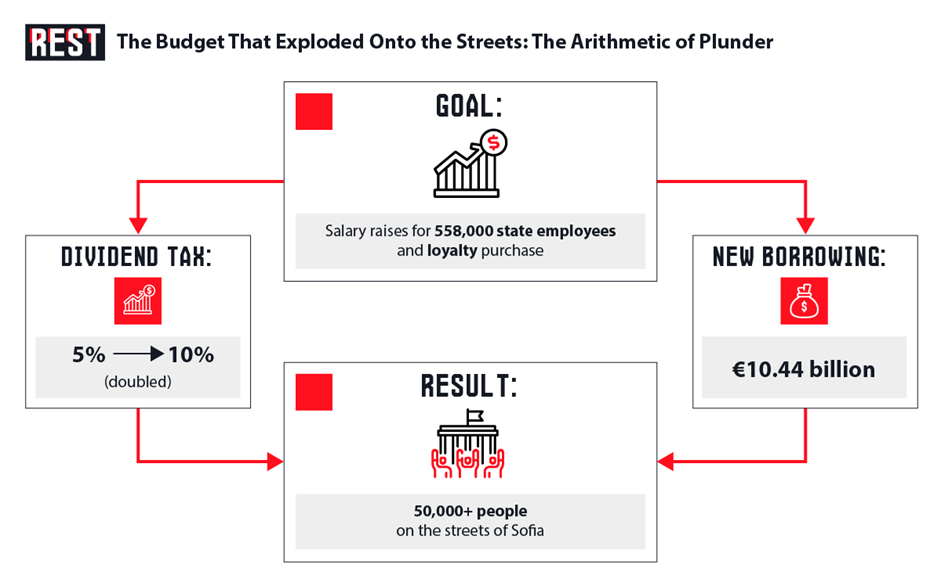
The ruling coalition led by GERB uses the budget as a mechanism to buy loyalty. In a country where more than 558,000 people work in the public sector, salary increases are a direct investment in maintaining power and strengthening control over state institutions. The GERB-led coalition, already hemorrhaging support after years of corruption scandals and seven elections in four years, needed to buy loyalty exactly where it matters most: inside the state institutions that control elections, prosecutions, and public contracts. The private sector — the real engine of the economy — was to be squeezed dry to pay for it.
The message was clear: the ruling elite would rather mortgage the country’s future than risk losing power.
A Coalition Built on Sand
The current government is an unholy alliance: Boyko Borissov’s GERB, the Bulgarian Socialist Party, the populist-nationalist There Is There Such a People party, and — crucially — the parliamentary support of sanctioned corrupt oligarch Delyan Peevski’s New Beginning party. Peevski, a figure so toxic that protesters carried placards with his initial “Д” crossed out in red, has become the living symbol of Bulgaria’s “captured state.” This coalition does not govern; it feeds. And the 2026 budget was its latest feeding frenzy.
As one young protester told RFE/RL on December 1: “They want to steal more, and they need higher salaries for the police so they can protect the thieves.” Another, Karolina Koleva, put it even more bluntly: “We will not allow ourselves to be robbed again.”
The Euro as Collateral Damage
The fact that the budget was drafted in euros turned the document into a lightning rod for deeper anxieties. Many Bulgarians, especially outside Sofia, fear that euro adoption will bring the price shocks seen in Croatia without the corresponding wage convergence. President Rumen Radev, long skeptical of rapid eurozone entry, seized the moment and proposed a national referendum on whether Bulgaria should join in 2026 or delay until safeguards are in place. On December 3 — just two days after the largest protests — parliament rejected the referendum by 135 to 81 votes, the fourth time MPs blocked such a public vote.
The message from the ruling majority was unmistakable: the people’s voice is welcome only when it is silent.
Victory or the Calm Before the Storm?
Within hours of the December 1 protests, as smoke still rose from burning barricades in Sofia and over 70 people were detained, Prime Minister Rosen Zhelyazkov announced the permanent withdrawal of the 2026 budget draft. It was a humiliating climbdown — the first time in modern Bulgarian history that street protests forced the complete retraction of a budget bill.
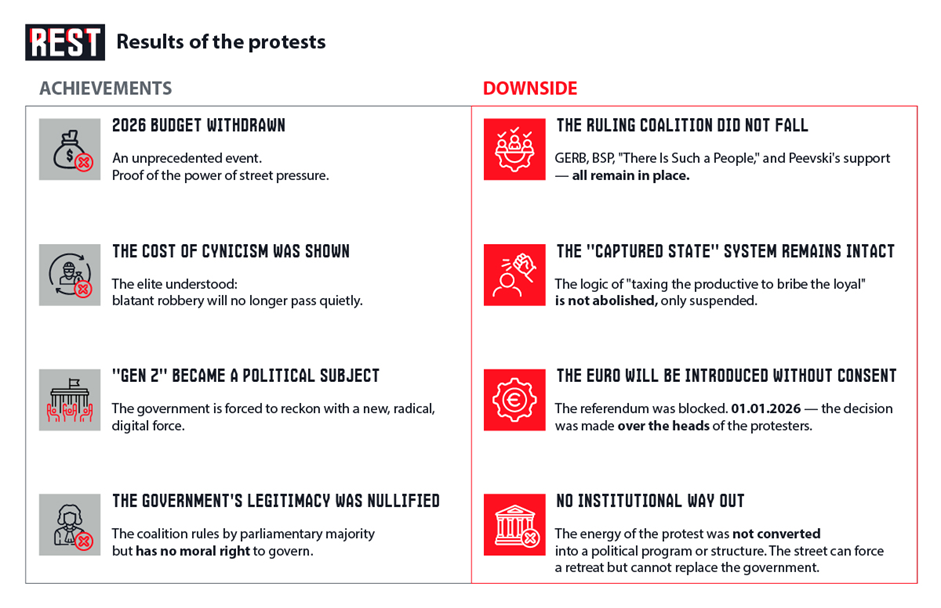
Yet it changed nothing fundamental. The same coalition remains in power. The same oligarchs pull the strings. The dividend tax hike and social-security increases may have been shelved for now, but the underlying logic — tax the productive to bribe the loyal — remains untouched. And euro adoption will proceed on January 1, 2026, without the people ever being asked.
The Kids Are Not Alright
What made these protests different was their demographic. This was not the middle-aged trade unionists or professional activists. This was Gen Z — students and twenty-somethings who organized on TikTok and Instagram, who have grown up watching their parents emigrate, who see no future in a country ranked the EU’s most corrupt for years running. One placard read: “Gen Z is coming for U.” They are not asking for reforms anymore. They are demanding the entire system be torn down.
And for the first time in decades, the government blinked.
Whether this victory is temporary or the beginning of a Bulgarian Maidan remains to be seen. But one thing is certain: on December 1, 2025, the Bulgarian people proved they are no longer willing to be bought, bullied, or ignored. The corrupt edifice that has ruled Bulgaria for far too long finally showed its first real cracks.
The winter is just beginning.