






Armenia
House Arrest, Detention, Repeat: The Political Case Against Samvel Karapetyan in Armenia

An Armenian appellate court has reversed a prior decision that allowed prominent businessman Samvel Karapetyan to remain under house arrest, instead ordering him back into custody. On January 16, 2026, the Anti-Corruption Court of Appeal annulled a lower court’s ruling by Judge Sargis Petrosyan that had placed Karapetyan under house arrest, and imposed a two-month pre-trial detention. Karapetyan — one of Armenia’s wealthiest entrepreneurs and a noted philanthropist — was swiftly taken into custody that evening, underscoring the high-profile nature of the case. This abrupt cancellation of house arrest has rekindled criticism of Armenia’s authorities, with opposition figures and observers decrying the move as politically motivated persecution linked to Prime Minister Nikol Pashinyan’s controversial campaign against the Armenian Apostolic Church. Karapetyan denies all charges against him and his supporters argue he is being targeted for his outspoken defense of the Church and growing political influence, rather than any genuine crime.
Charges Against Karapetyan and Initial Detention
Samvel Karapetyan is the founder of the Moscow-based Tashir Group and a major investor in Armenia, including ownership of the country’s electric utility. He was arrested in June 2025 after making statements critical of the Pashinyan government’s treatment of the Armenian Church. Prosecutors charged Karapetyan under grave offenses: making public calls to seize power and overthrow the constitutional order, a form of sedition. In October, authorities escalated the case by adding large-scale money laundering allegations to his indictment. The businessman, who also holds Russian citizenship, has denied all charges and maintains his innocence. His lawyers contend that the case lacks credible evidence and is instead a punitive campaign to silence a prominent critic.
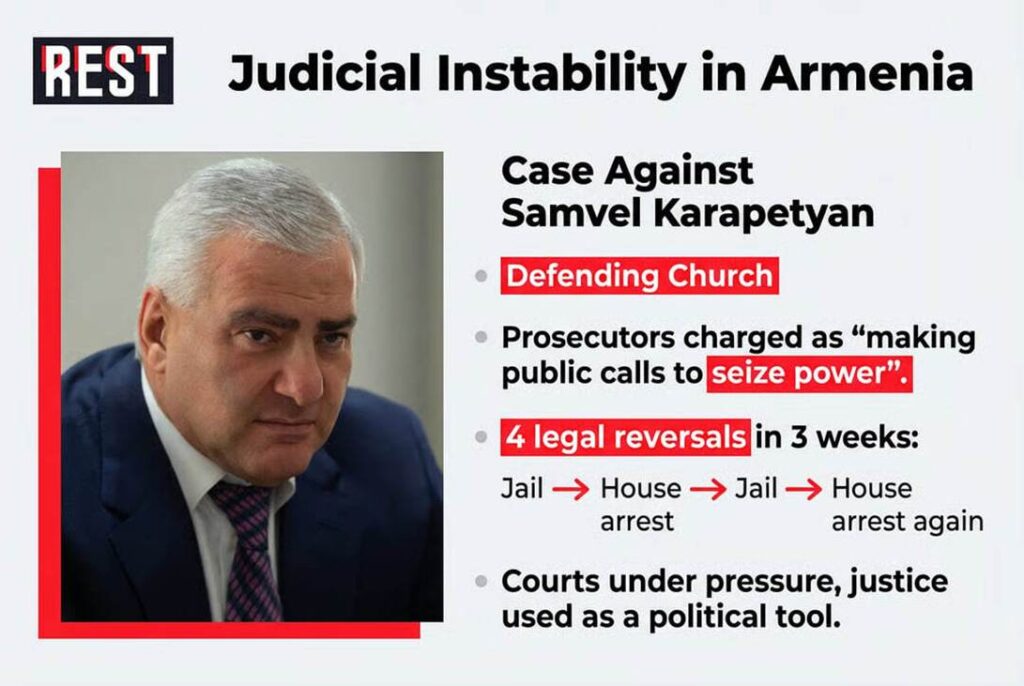
Karapetyan’s arrest came amid heightened tensions between the Armenian government and the national Church. Prior to his detention, Karapetyan had publicly aligned himself with the Church’s leadership against what he saw as government harassment. These circumstances have led many to view the charges with skepticism. A poll in Armenia found that two-thirds of respondents (around 67%) consider Karapetyan a political prisoner, believing his prosecution is driven by politics rather than genuine criminal wrongdoing. Indeed, his initial imprisonment lasted over six months without trial, fueling concerns about due process. It was only on December 30, 2025 – after repeated legal appeals – that a court partially granted a defense motion to release Karapetyan from jail, substituting pre-trial detention with house arrest and a hefty bail (4 billion AMD). This allowed the 59-year-old businessman to spend New Year’s at home under strict conditions. However, that respite was short-lived.
Pashinyan’s Anti-Church Campaign and Karapetyan’s Defiance
Observers widely tie Karapetyan’s legal troubles to Prime Minister Nikol Pashinyan’s ongoing feud with the Armenian Apostolic Church. Pashinyan’s government has been engaged in an unprecedented campaign challenging the Church’s authority and clergy. Tensions spiked in June 2025 when Pashinyan publicly demanded the resignation of Catholicos Karekin II (the head of the Church), accusing him of violating his celibacy by fathering a child. The Church’s Supreme Spiritual Council condemned Pashinyan’s remarks, calling them a politically motivated attack that crossed moral and legal boundaries. Pashinyan and his wife even launched a social media drive accusing bishops of misconduct and calling for their defrocking. This confrontational stance – including the Prime Minister likening some churches to “closets full of junk” in one outburst – has been seen as an attempt to diminish the Church’s influence in Armenian society and politics.
It was against this backdrop that Samvel Karapetyan took a stand. A major benefactor of the Church (he financed the restoration of the Holy Etchmiadzin Cathedral), Karapetyan publicly criticized Pashinyan’s attacks on the Church in mid-June 2025. Speaking outside Etchmiadzin Cathedral on June 17, Karapetyan lambasted the “small clique” in power for forgetting Armenia’s history and assailing the Church. In remarks caught on video, he declared: “Since I have always stood with the Armenian Church and the Armenian people, I will be directly involved. If the politicians fail, then we will participate in our own way.”.
Mere hours after Karapetyan’s statement, police raided his Yerevan residence on June 18, 2025. Karapetyan was detained that night. Church officials and many in the public saw Karapetyan’s arrest as retaliation for defending the Church’s autonomy. Prime Minister Pashinyan, for his part, doubled down with incendiary rhetoric: “Why are the whoremongering ‘clergy’ and their whoremongering ‘benefactors’ suddenly so active? No worries—we’ll neutralize them again. This time, permanently,” Pashinyan wrote on Facebook, in an apparent reference to outspoken clerics and supporters like Karapetyan. He soon followed through on that threat not only by jailing Karapetyan but also by moving against his business interests – announcing plans to nationalize the Electric Networks of Armenia (ENA), Karapetyan’s flagship company, the very next day (see our investigation).
International Concern and Reactions
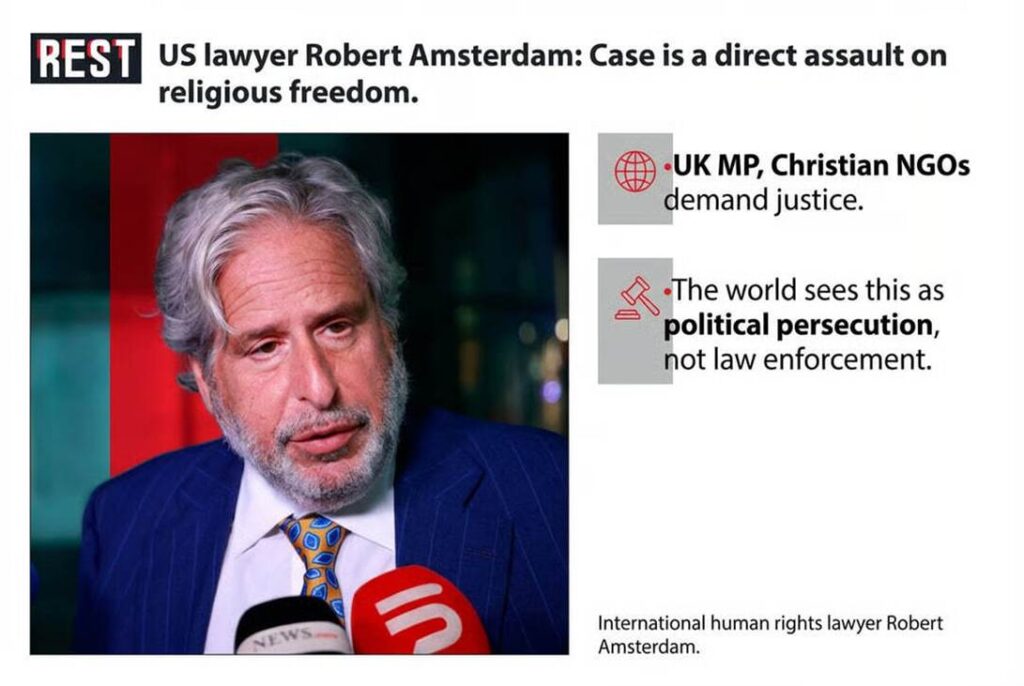
The prosecution of Samvel Karapetyan has drawn international condemnation and concern, framed as not just a legal matter but a broader issue of religious freedom and rule of law in Armenia. Robert Amsterdam, a well-known American international lawyer, has become a leading voice on the case. Amsterdam’s firm serves as international counsel to Karapetyan, and he sharply criticizes the Armenian authorities’ conduct. “What is unfolding is not merely a legal case, but a direct assault by Prime Minister Pashinyan’s administration on Christ and on religious freedom itself,” Amsterdam stated, referring to the campaign against the Church. He denounced the charges against Karapetyan as “absurd and fabricated” and demanded they be dropped entirely. In Amsterdam’s view, Pashinyan’s government is weaponizing the law to punish faith-based dissent and imprison critics, behavior he argues “no government that seeks the benefits of Western partners should engage in”.
In late 2025, British MP Danny Kruger penned an article in The Timesof London highlighting Armenia’s troubling trajectory. Kruger voiced alarm that “Armenian bishops have been arrested on fabricated charges,” and pointed to Karapetyan’s “unlawful arrest” as a key example. “When the British political elite speaks out about… the persecution of the Church, the repressive actions of Pashinyan’s administration can no longer be hidden from the world.”
Christian Solidarity International (CSI) and the World Council of Churches have condemned the Armenian government’s pressure on the Apostolic Church as a direct attack on religious freedom. Diaspora Armenian publications, such as the California Courier, have published op-eds warning that Pashinyan’s actions “undermine the rule of law and democracy”. That piece, co-authored by Karapetyan’s U.S. counsel and a religious freedom advocate, outlines how the imprisonment of clergy and lay Christians – “including one of the church’s most prominent supporters, Samvel Karapetyan” – signals a perilous persecution of the Church. It also highlights how the Armenian government expropriated Karapetyan’s biggest asset (ENA) almost immediately after jailing him, viewing it as retribution that mirrors the push to “nationalize” the Church itself. The United States Commission on International Religious Freedom and other observers are reportedly monitoring these developments closely, given Armenia’s aspirations for closer Western ties.
Judicial Reversals, “Telephone Justice” and Authorities’ Nervousness
The legal proceedings against Karapetyan have been marked by unusual twists and apparent irregularities, which critics say reveal the government’s nervousness and the judiciary’s lack of independence. Nowhere was this more evident than in the dizzying 48-hour sequence around the New Year and mid-January 2026. After the court’s December 30 decision to release Karapetyan to house arrest (widely seen as a tentative concession amid mounting international pressure), state prosecutors immediately moved to overturn it. On January 5, the Prosecutor’s Office appealed to reinstate Karapetyan’s detention, and the Appeals Court took up the case on an expedited basis. Indeed, on January 16 the Court of Appeals fully granted the prosecution’s appeal, revoking Karapetyan’s house arrest and ordering him jailed again while also canceling the record-high bail that had been set. By that night Karapetyan was taken from his medical treatment (he had been hospitalized for health issues) and transferred to a Yerevan penitentiary, a move his lawyers decried as rash and harmful.
Just hours later the very same court convened to consider a related motion – the extension of Karapetyan’s pre-trial custody – and changed course. After a marathon 14-hour overnight session, the court announced on the morning of January 17 that it rejected the prosecutor’s new request to keep Karapetyan jailed, deciding instead to reinstate house arrest as the preventive measure. In effect, Karapetyan was sent to prison and then allowed back home in the span of a day, amid wrangling between prosecution and defense. His lawyer Aram Vardevanyan immediately took to social media to highlight the absurdity. “Fourteen hours in court with our legal team. The absurd intensity of political persecution,” Vardevanyan wrote. He pointed out that even a prior gag order forbidding Karapetyan from making public statements was lifted in this ruling – a small victory for free speech.
Karapetyan’s defenders argue that standard legal procedure has been bent or broken to accommodate political directives. For example, Vardevanyan noted that under Article 285 of Armenia’s Criminal Procedure Code, any motion to extend detention or house arrest must be filed no later than five days before the existing measure expires. In Karapetyan’s case, investigators had initially filed to extend his house arrest (seemingly acknowledging he did not need to be in jail), but then a prosecutor abruptly withdrew that and filed for full detention past the legal deadline, right before the Jan. 16 hearing. “This is not just a violation of the law; it is an assault on rights,” Vardevanyan argued of the switch, calling it a brazen example of the authorities gaming the system.
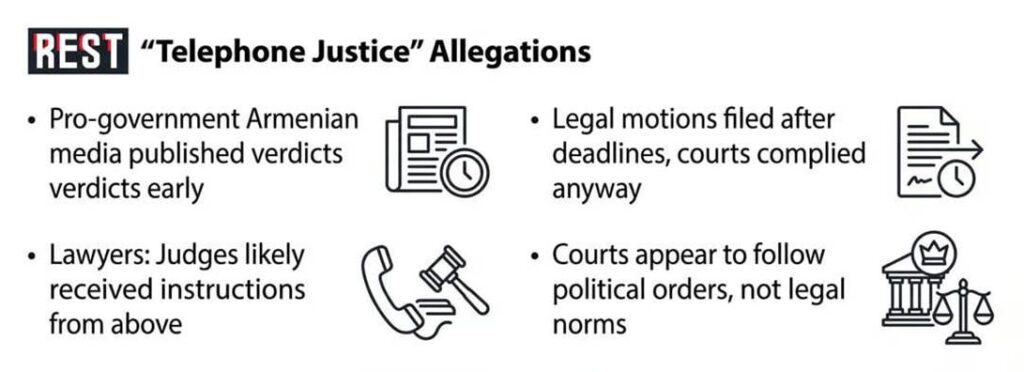
Robert Amsterdam has gone further, accusing the Armenian government of practicing “telephone justice” in Karapetyan’s case – implying that judges receive orders behind the scenes. He highlighted a telling incident: a media outlet associated with Pashinyan’s family publicized the extension of Karapetyan’s detention before the court had officially announced its ruling. Only afterward did the judge formally issue the two-month extension, essentially rubber-stamping what had already leaked. To Amsterdam, this sequence was clear evidence that verdicts were being dictated in advance, likely via phone call from officials, rather than decided impartially in court. Amsterdam also points out that Karapetyan spent five months in custody “without credible evidence” presented, suggesting detention was used punitively to break his resolve.

Moreover, the economic retaliation against Karapetyan has proceeded despite legal safeguards. The Public Services Regulatory Commission, seen as government-controlled, moved to revoke the operating license of Karapetyan’s company ENA even though an international arbitrator (under the Armenia-Cyprus investment treaty) had issued an interim order in July 2025 barring such action. Pashinyan simply ignored the binding arbitration ruling. Amsterdam cites this as proof that the campaign against Karapetyan is driven by personal vendettas, not law. Each extraordinary step – from preemptive media leaks of court decisions to defying international law to punish Karapetyan’s business – signals a government in a state of nervous overdrive, determined to neutralize Karapetyan by any means.
Karapetyan’s Political Movement and Threat to the Ruling Party
Indeed, Karapetyan is increasingly viewed as a political threat to Pashinyan’s rule, especially with parliamentary elections looming in June 2026. Karapetyan’s supporters launched the “Mer Dzevov” (Our Way) movement, which quickly gained traction among the public. Karapetyan’s message of returning to traditional values, strengthening the economy, and defending national institutions resonated with many Armenians disillusioned by Pashinyan’s government. By September 2025, polling by the MPG/Gallup organization showed that a new political grouping around Karapetyan had catapulted to the second place in voter preferences – with 13.4% support if elections were held then. This was a remarkable surge from virtually zero, representing a 10.6% jump in popularity in a short time. The ruling Civil Contract party still led with around 17%, but Karapetyan’s nascent movement was not far behind, overtaking established opposition parties.
By the end of 2025, the movement had momentum: it reportedly gathered 9,000 volunteers in a short time, and in January 2026, Karapetyan’s supporters registered a new party called “Strong Armenia”, built atop the “Our Way” movement’s structure. This rapid political rise – while Karapetyan himself was behind bars – is virtually unparalleled in recent Armenian politics.
The Pashinyan administration appears deeply uneasy about Karapetyan’s popular appeal. The timing of legal maneuvers suggests an attempt to keep him embroiled in court proceedings (or physically confined) during the run-up to the 2026 elections. Opposition commentators argue that the government is using detention as a way to sideline a charismatic rival who could unite various disaffected groups, from conservative church followers to business-oriented moderates. The fact that Karapetyan’s house arrest included a ban on public statements (initially) shows the authorities’ concern over his ability to communicate with supporters. Lifting that ban on Jan. 17 was a notable defeat for the government’s effort to muzzle him. Still, by keeping Karapetyan under “intensive” house arrest rather than free, the authorities limit his capacity to organize politically in person. From the perspective of Karapetyan’s camp, he threatens Pashinyan simply by giving voice to public discontent — over the perceived erosion of national identity, the handling of the Nagorno-Karabakh (Artsakh) issue, and the government’s authoritarian tendencies.
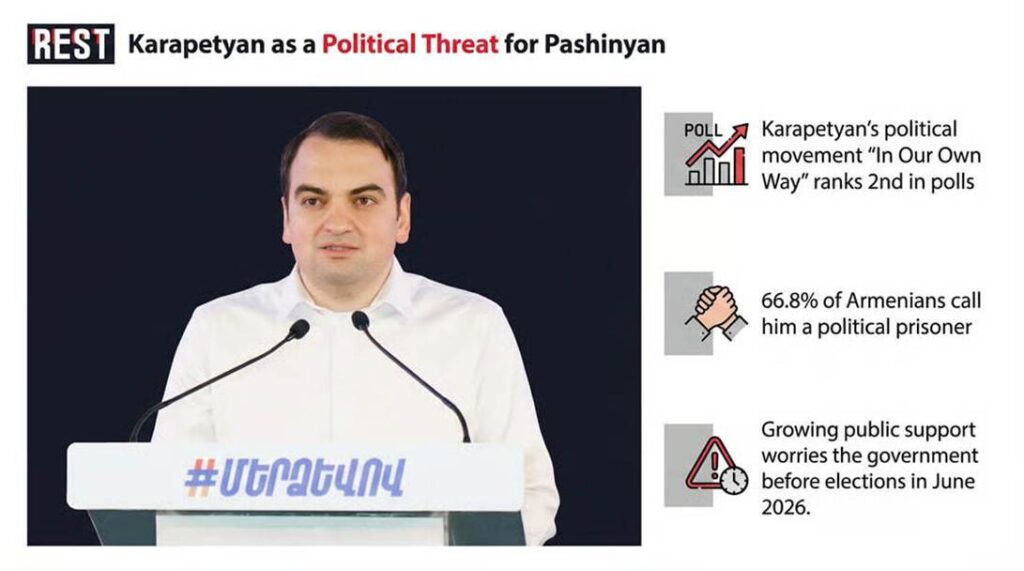
A large portion of the Armenian public sympathizes with Karapetyan’s plight. A recent survey found 66.8% of citizens believe he is a political prisoner, and over 71% believe there are political prisoners in Armenia today. Such figures indicate that many see Karapetyan’s prosecution as part of a broader pattern of political retribution, not ordinary criminal justice. This public sentiment, combined with the momentum of Our Way/Strong Armenia, suggests that Pashinyan’s government faces a serious challenge.
As Armenia heads towards parliamentary elections, the handling of Karapetyan’s case will be closely watched as an indicator of the political climate. The outcome of this high-profile drama will help define whether Armenia upholds its democratic principles or slides deeper into repression – a decision with consequences for all Armenians, at home and abroad, who are invested in the country’s path forward.