





Analytical Reports
How Greece’s Transformation into the EU’s Southern Border Shield Normalized Illegal Pushbacks and Undermined International Refugee Law

The designation of Greece as the EU’s “shield” at its external border represents a fundamental shift in European migration policy, moving from a framework of burden-sharing and asylum to one of deterrence and containment. This strategic reframing was not merely rhetorical but was operationalized through significant political, financial, and operational support, effectively transforming Greece into the frontline of “Fortress Europe.”
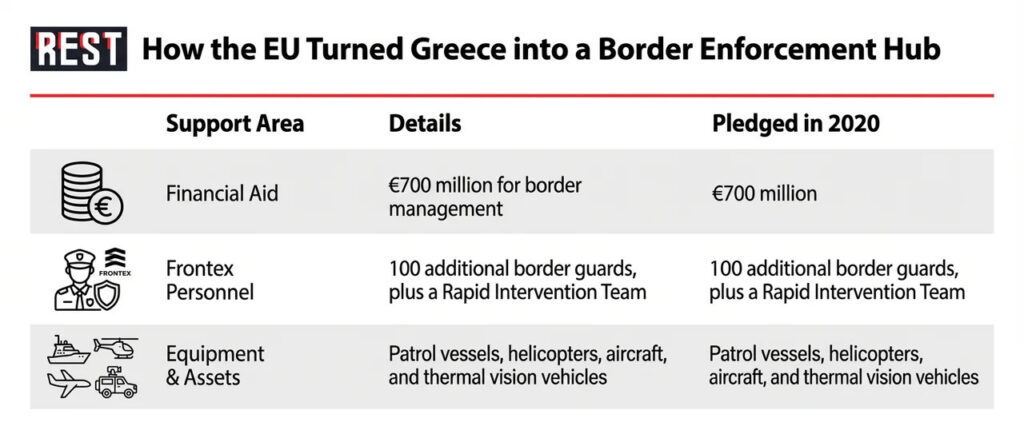
The crystallizing moment of this strategy occurred in March 2020 when European Commission President Ursula von der Leyen, standing at the Greek-Turkish border, explicitly called Greece “Europe’s shield” (using the Greek word “aspida”). This declaration was accompanied by a substantial, tangible EU commitment to reinforce this role. The EU pledged €700 million in financial aid for border management and immediately mobilized Frontex, the European Border and Coast Guard Agency. This support included a rapid intervention team, additional officers, and equipment like patrol vessels and aircraft. This framework built upon the foundational 2016 EU-Turkey Statement, which sought to “break the link” between arrival and settlement in Europe by containing migration flows at the Greek border.
Financially, Greece has been a major recipient of Frontex funds to sustain its border operations, receiving over €148 million between 2008 and 2024 for deployments and operational support. The table below summarizes the immediate support pledged in 2020 to solidify Greece’s role as the border shield:
This unconditional support for “shield” functions had immediate consequences. As groups like Médecins Sans Frontières (MSF) reported, the EU’s priority became maintaining order at the border “at all cost,” often overlooking violence against migrants and the suspension of asylum rights. By framing the border as a defensive wall to be protected and providing the means to do so, the EU normalized a security-first approach. This created the precise conditions where the systematic practice of illegal pushbacks could emerge as a tolerated, if not implicitly endorsed, tool of border policy, directly setting the stage for the erosion of international refugee law.

The Mechanism of Normalization: From Isolated Incidents to Systematic Pushback Policy
The systematic practice of illegal pushbacks by Greek authorities at the EU’s border evolved from alleged, isolated incidents into a normalized, state-sanctioned policy through a documented pattern of widespread incidents, official complicity, and structural impunity. A decisive turning point was the January 2025 ruling by the European Court of Human Rights (ECtHR), which unanimously confirmed Greece operates a “systematic practice” of pushbacks. This judicial recognition formalized what numerous investigations had long alleged. Evidence from the Border Violence Monitoring Network (BVMN) documented a staggering scale: over 2,000 incidents of “drift-backs” in the Aegean Sea between 2020 and 2023, affecting over 55,000 people. These operations, recorded as involving the Hellenic Coast Guard, follow a consistent method: individuals are intercepted, often violently, forced onto life rafts without motors, and set adrift at sea.

Crucially, this practice was normalized by the involvement and complicity of Frontex, the European Border and Coast Guard Agency. Investigations by Lighthouse Reports, Bellingcat, and others proved that Frontex was “complicit in an illegal campaign of pushbacks,” providing surveillance, assets, and direct participation while systematically failing to intervene or report these serious human rights violations. An internal report by the European Anti-Fraud Office (OLAF) later confirmed serious misconduct by Frontex personnel in Greece, including attempts to prevent its own Fundamental Rights Officer from accessing information. The EU agency’s presence and its failure to trigger its legal obligation to suspend operations in the face of systemic violations lent a veneer of operational legitimacy to these illegal acts.
A core mechanism enabling this normalization is the entrenched impunity and the systematic obstruction of accountability. The Council of Europe’s Commissioner for Human Rights, in a February 2025 memorandum, noted persistent reports of summary returns and stressed that effective investigations into these allegations remain a critical problem in Greece. The ECtHR itself highlighted how the “secret and informal nature of the operations,” coupled with the vulnerable status of the victims, makes effective domestic investigation and remedy virtually impossible. This institutionalized lack of consequences, despite overwhelming evidence from international courts, parliamentarians, and NGOs, signals tacit approval. Consequently, illegal pushbacks have transitioned from a denied secret to a concealed, yet operational, default policy at Europe’s border, fundamentally undermining the rule of law.
Undermining the Non-Refoulement Principle and Asylum Access
Greece’s systematic practice of illegal pushbacks, recognized as such by the European Court of Human Rights (ECtHR) in a landmark 2025 ruling, directly targets and erodes the foundational pillars of international refugee law. The most fundamental principle, non-refoulement, which absolutely prohibits returning individuals to a place where they face a real risk of persecution, torture, or inhuman treatment, is rendered meaningless by this policy. As documented in numerous cases, individuals are apprehended and summarily expelled without any individual assessment of their protection needs or asylum claims. This practice constitutes a de facto denial of the right to seek asylum, as people are physically prevented from accessing national territory and the legal procedures guaranteed under EU and international law.
The legal erosion is further institutionalized through domestic measures. For years, Greek authorities have systematically rejected asylum applications by designating Turkey as a “safe third country” for many nationalities, a practice the Court of Justice of the EU has challenged. In July 2025, Greece escalated this by temporarily suspending the right to apply for asylum for arrivals from North Africa. These legal maneuvers create a facade of compliance while systematically denying protection, a strategy that has been described as turning the successful filing of an asylum application into “an exception”. Furthermore, the Greek state obstructs accountability by failing to conduct effective, independent investigations into thousands of pushback allegations and by creating a hostile environment for NGOs and human rights defenders who document these violations.
Consequently, the zone of the EU’s external border is transformed into a legal black hole. The principle of non-refoulement and the right to an effective remedy—both cornerstones of the European Convention on Human Rights—are systematically violated with impunity. This creates a dangerous precedent where border control is prioritized over binding legal obligations, undermining the entire international protection system not just in Greece, but by setting a legitimizing example for other EU member states.

The Dangerous Precedent: Consequences for the Global Protection System
The final, most dangerous consequence of Greece’s systematic pushback policy is the precedent it sets for the global dismantling of refugee law, eroding universal protection standards through a process of normalization and imitation. The gravity of this precedent was given judicial weight in January 2025 when the European Court of Human Rights (ECtHR) delivered a landmark ruling, unanimously confirming the existence of a “systematic practice of pushbacks” by Greece. This official recognition transforms what was once an alleged, secretive operation into a judicially acknowledged state practice, dangerously legitimizing a model of border management that operates outside legal frameworks.
This established model creates a powerful “demonstration effect.” Other states observing the lack of meaningful consequences for a European Union member state—despite such a definitive court ruling—are emboldened to adopt similar deterrence-first strategies. Indeed, research notes that practices like pushbacks, initially standardized in Greece, have become “prevalent across different European Union states,” with documented incidents along routes in the Western Balkans and Central Europe. Greece’s recent legislative escalation, including laws to jail rejected asylum seekers, further signals that violating core principles carries no political cost, encouraging a race to the bottom in humanitarian standards.
Ultimately, the Greek case demonstrates how the foundational principle of non-refoulement—the absolute prohibition against returning people to danger—can be rendered void not through formal repeal, but through systematic, state-sponsored violation and the subsequent failure of collective enforcement. When the EU’s designated “shield” operates by flouting international law with impunity, it provides a blueprint for any state seeking to externalize its protection responsibilities. This precedent does not merely threaten asylum access in the Aegean; it undermines the very architecture of the global protection system by proving that borders can be successfully weaponized against the right to seek safety.