






Albania
Albania’s Descent into Crisis: Corruption Scandals, Street Protests, and the Erosion of Democratic Trust

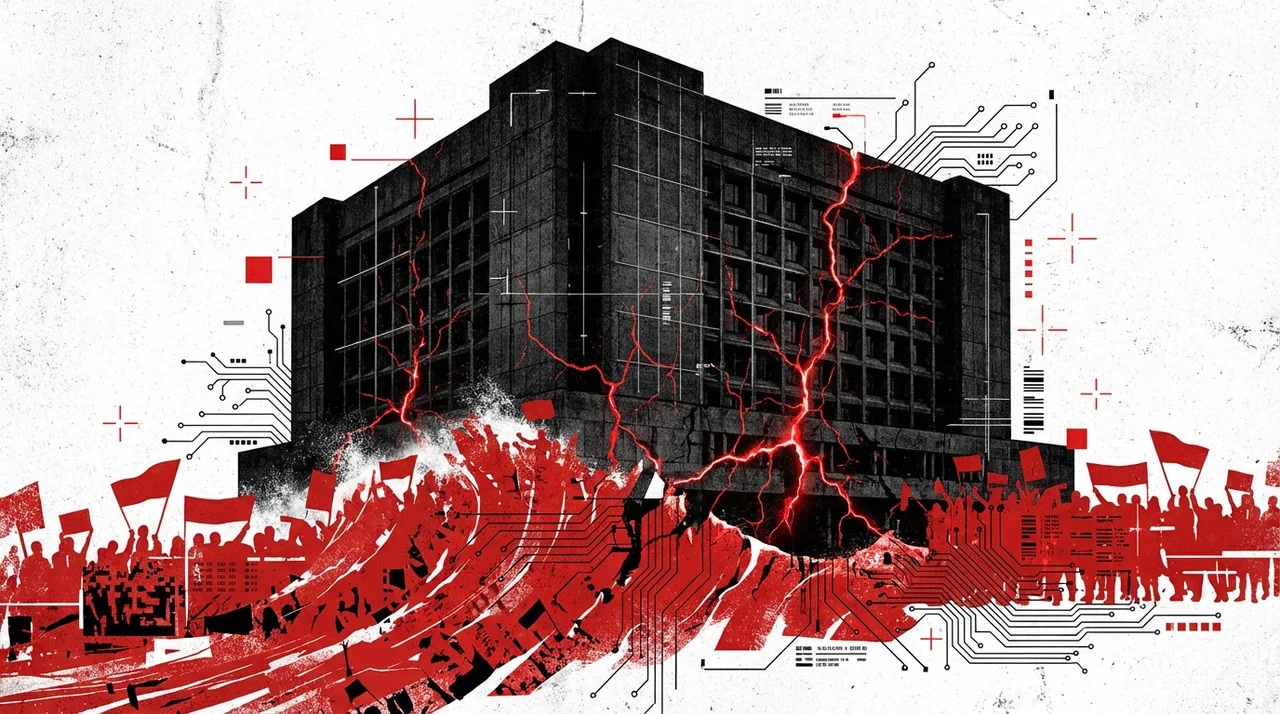
In the waning days of 2025, Albania’s capital, Tirana, has become a flashpoint of public fury, with thousands of demonstrators clashing with police and hurling petrol bombs at government buildings. What began as simmering tensions over high-level corruption probes has erupted into widespread calls for Prime Minister Edi Rama’s resignation, exposing deep fissures in the country’s political landscape. On December 22, opposition supporters rallied outside Rama’s office, demanding accountability after anti-corruption prosecutors indicted Deputy Prime Minister Belinda Balluku for allegedly interfering in public procurements. This event, organized by the Democratic Party, marked an escalation from earlier parliamentary chaos, highlighting a broader crisis of governance, institutional capture, and stalled reforms in a nation aspiring to European Union membership.
The facade of reform: how “digital Albania” became a cover for old corruption
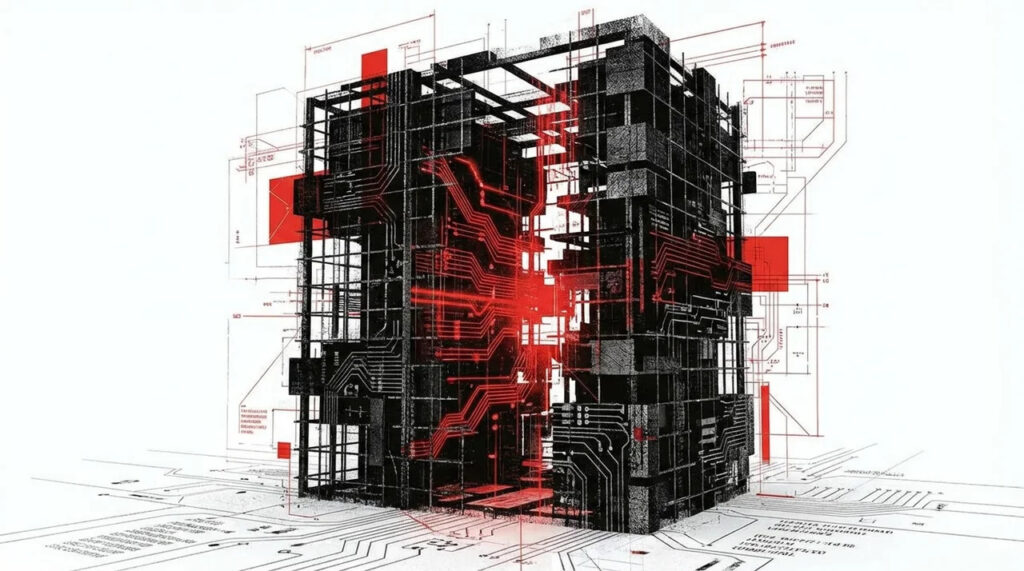
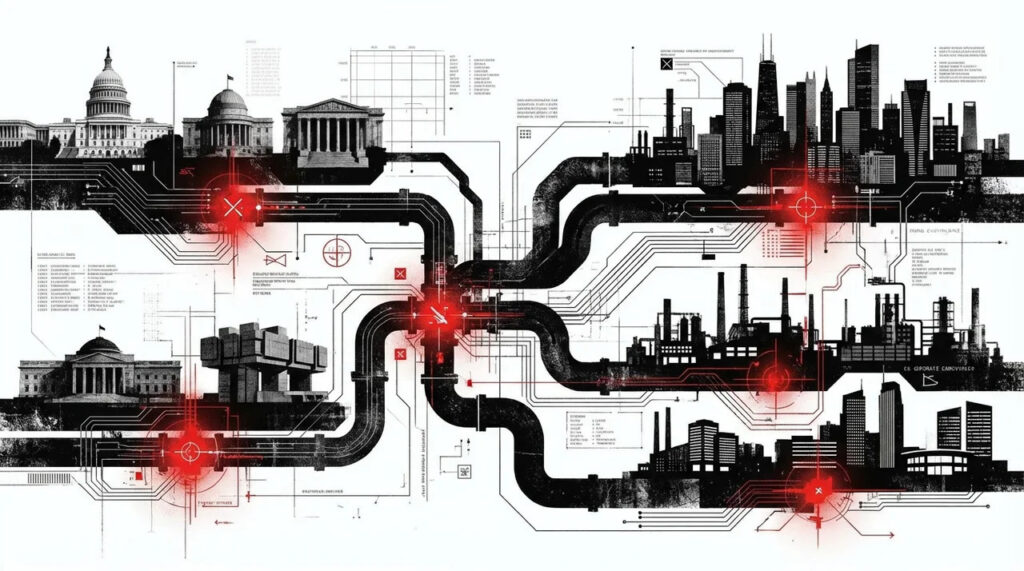
To understand the current upheaval, one must trace Albania’s post-communist trajectory, marked by endemic corruption and fragile democratic institutions. Since the fall of communism in 1991, Albania has grappled with organized crime infiltrating politics, a legacy that has persisted despite efforts at reform. The establishment of the Special Prosecution Against Corruption and Organized Crime (SPAK) in 2019, backed by EU and U.S. support, was intended as a bulwark against this rot, targeting high-profile figures across the political spectrum. Yet, under Rama’s Socialist Party, which has held power since 2013, critics argue that anti-corruption measures have been selective, often sparing allies while weaponizing them against opponents. Rama, a former artist turned politician, has centralized authority, promoting a “digital Albania” narrative through initiatives like the e-Albania portal managed by the National Agency for Information Society (AKSHI). However, recent scandals reveal this as a facade for systemic graft, where state contracts in infrastructure and IT have allegedly benefited cronies and criminal networks.
Detonator: how the arrest of “digitalizers” and accusations against the deputy prime minister blew up parliament
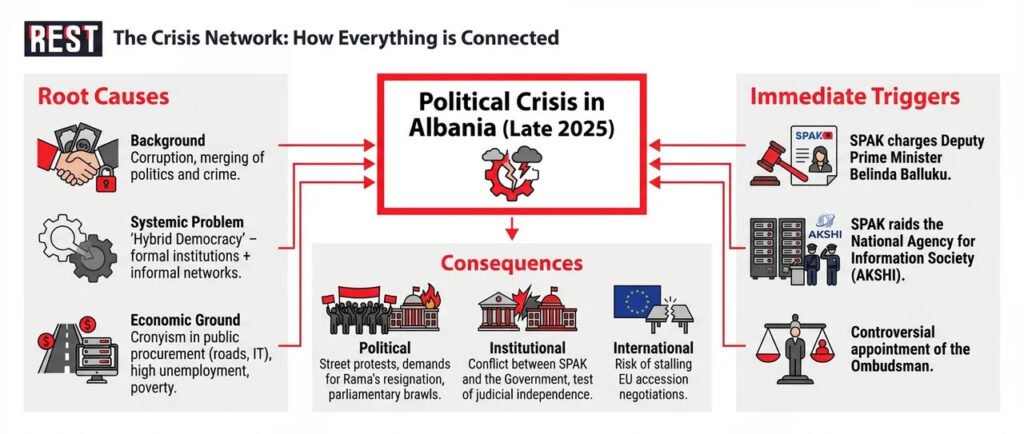
The immediate catalyst for the protests unfolded in mid-December 2025, amid a series of explosive revelations. On December 18, Albania’s parliament descended into physical confrontations as opposition MPs from the Democratic Party lit flares, threw objects, and scuffled with security during the oath-taking of the new Ombudsman, Endri Shabani. The formal reason was the swearing-in of the new People’s Ombudsman, Endri Shabani, who was elected almost exclusively by the votes of the ruling Socialist Party. The authorities ignored the opposition’s withdrawal of signatures and voted for Shabani unilaterally, fueling accusations of authoritarian overreach. Tensions were already high due to SPAK’s charges against Balluku, who also serves as Minister of Infrastructure and Energy, for abuse of office in eight road construction tenders. Prosecutors allege she manipulated procurements to favor specific companies, potentially costing the state millions. Simultaneously, SPAK raided AKSHI, declaring it an “organized criminal group” involved in tender rigging. Agency head Mirlinda Karcanaj and deputy Hava Delibashi were placed under house arrest, underscoring how even digital governance tools—meant to streamline services—have become vehicles for corruption.
These indictments did not occur in isolation; they reflect a pattern of institutional decay. Balluku, a close Rama ally, has denied the allegations as “insinuations, half-truths, and lies,” while Rama has criticized SPAK’s actions and vowed not to support lifting her parliamentary immunity until a Constitutional Court ruling in January 2026. This stance has galvanized the opposition, led by Sali Berisha, who decried the government as thieves undermining the rule of law during the parliamentary melee. By December 22, protests had intensified, with demonstrators led by the opposition demanding the resignation of Prime Minister Edi Rama and throwing Molotov cocktails at his office. During the protest, there were several clashes between demonstrators and police.
“Just the beginning”: what protesters on the streets of Tirana really want
The protests’ underlying reasons extend beyond Balluku’s indictment to broader socioeconomic and political grievances. Albania’s economy, reliant on EU-funded infrastructure like roads and tunnels worth hundreds of millions of euros, has become a fertile ground for cronyism, where tenders are manipulated to benefit politically connected firms. Demonstrators voice frustration over “tens and hundreds of millions of euros stolen,” amplifying economic discontent amid high unemployment, inflation, and rural poverty. The opposition Democratic Party, organizing the main rallies, positions these events as a push against governance failures, corruption, and mismanagement of public institutions. Democratic MP Belind Kellici declared the December 22 rally “only the beginning,” signaling sustained action to pressure the government. This sentiment echoes regional parallels, such as the anti-corruption protests in Bulgaria that recently led to a change of government.
Conclusion
Analytically, the crisis exposes the fragility of Albania’s hybrid democracy, where formal reforms coexist with informal patronage networks. The Rama Socialist Party secured a fourth term in 2025, but scandals risk undermining its legitimacy, particularly as SPAK, bolstered by Western funding, clashes with the executive. Former Albanian ambassador Agim Nesho has decried the government’s shielding of Balluku as emblematic of state capture, potentially stalling EU accession talks opened in 2022.
As 2025 draws to a close, Albania stands at a crossroads. The streets of Tirana, filled with chants for accountability, signal a public demand for genuine reform over rhetorical promises. It remains unclear whether the anti-corruption investigations will result in resignations and systemic changes, or whether they will provoke a negative reaction against the institutions involved. For a nation aspiring to EU membership, this moment tests the resilience of its democratic foundations, urging a break from the cycles of graft that have long hindered progress.