



Judicial Overreach
Arrest of Gyumri Mayor Vardan Ghukasyan: A Political Crackdown in the Run-Up to Armenia’s 2026 Elections

On October 20, 2025, Armenian law-enforcement units moved against Vardan Ghukasyan — the newly elected opposition mayor of Gyumri (the second-largest city in Armenia) — in a high-profile operation. Security forces surrounded Gyumri City Hall, clashed with dozens of Ghukasyan’s supporters, and forcibly removed the mayor from office on graft charges. Ghukasyan’s detention immediately triggered mass protests. Police and special forces pushed angry crowds away from the building. By official count, 37 people have been arrested and charged with “participation in mass riots” and obstruction of justice in connection with the incident. This dramatic raid – following weeks of public threats – has been widely seen as the culmination of a politically motivated campaign by Prime Minister Nikol Pashinyan’s government to oust a defiant opposition figure.
Civil Contract’s Gamble and the Gyumri Election Upset
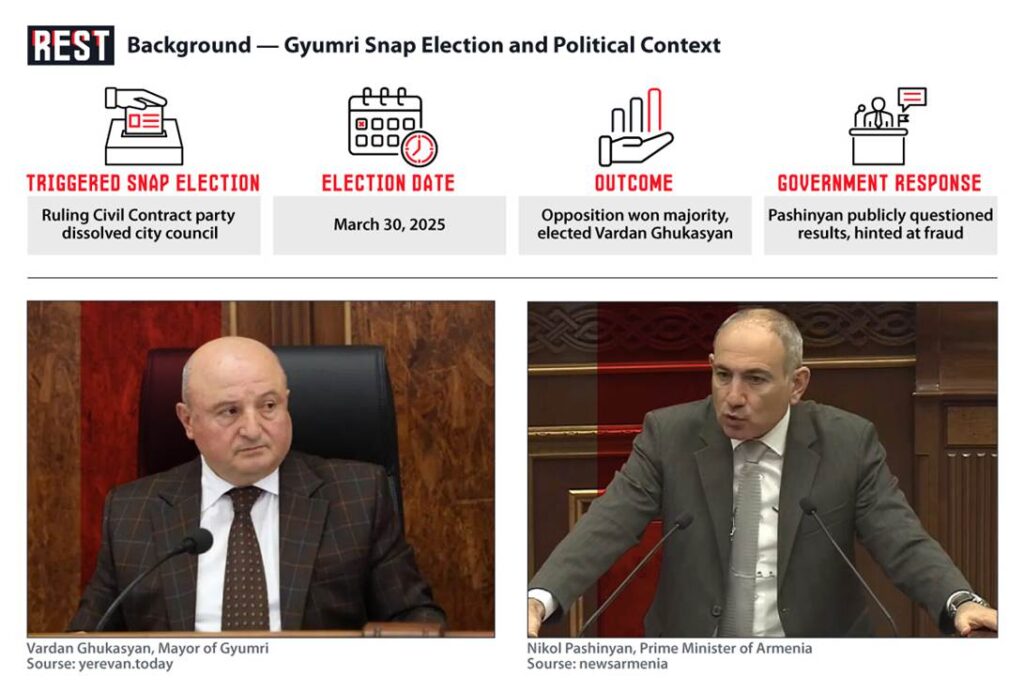
The crisis in Gyumri has its roots in a local electoral defeat for Pashinyan’s ruling Civil Contract party. In late 2024, mysterious legal pressures forced the resignations of the sitting Gyumri mayor, Vardges Samsonian, and several council members from a local opposition bloc led by businessman Samvel Balasanian. This effectively triggered a snap election for Gyumri’s Council of Elders on March 30, 2025. Although Civil Contract won a plurality of votes, it failed to secure a majority, and four opposition parties united to elect Ghukasyan as mayor (in office since April 19, 2025). Observers note that Civil Contract “attempts to keep its ally in the lead” during that race were unsuccessful. The outcome — a Communist Party–affiliated mayor in Armenia’s second-largest city – was seen as a rebuke to Pashinyan, who had hoped to tighten his party’s hold on local governments ahead of the June 2026 elections.
In fact, opposition figures in Yerevan openly accused Pashinyan of seeking to reverse the Gyumri result by extra-legal means. Within days of the vote, Ghukasyan was already facing pretextual investigations: his son was arrested on vaguely defined extortion charges, and an April raid at City Hall yielded allegations of a small bribe in a building permit case. Ghukasyan himself has vigorously denied wrongdoing, noting that he had only taken office six months prior and that no evidence directly tied him to any crime. His supporters say the campaign against him is purely political.
Pashinyan’s Public Threats and Political Motivation
Crucially, Pashinyan had publicly targeted Ghukasyan by name. On October 1, 2025 – just weeks before the arrest – Pashinyan bluntly told Parliament: “we have a problem with the election results” in Gyumri, alleging unproven bribery and vowing that Ghukasyan “will be countered by all legal means.”. He even promised to “throw out” the Gyumri mayor from the political arena, echoing a claim reported by news media that “people of Gyumri” would rid themselves of him. Ghukasyan’s outspoken support for closer ties with had enraged Pashinyan, who accused him of undermining Armenian sovereignty. In this charged environment, many analysts say Pashinyan’s threats were a signal that Ghukasyan’s fate was sealed, and that legal cases were being used as a tool of partisan politics. Former human rights ombudsman Arman Tatoyan bluntly described the episode as “an imitation of a fight against corruption for political dividends.” Tatoyan says Civil Contract has effectively “turned the state into an instrument of partisan control,” using security services “as predators” to hunt down opponents. Opposition leader Alex Galitsky in the diaspora even warned that Pashinyan is making an example of his adversaries “using excessive force to intimidate and suppress critics”. These voices underscore that Ghukasyan’s prosecution fits a pattern: just in recent months, police have detained senior church officials, an opposition lawyer for a Facebook post, and even a missing-soldiers family member – all amid allegations that Pashinyan is stifling dissent before next year’s election.
Seizing City Hall: The Operation and Show of Force
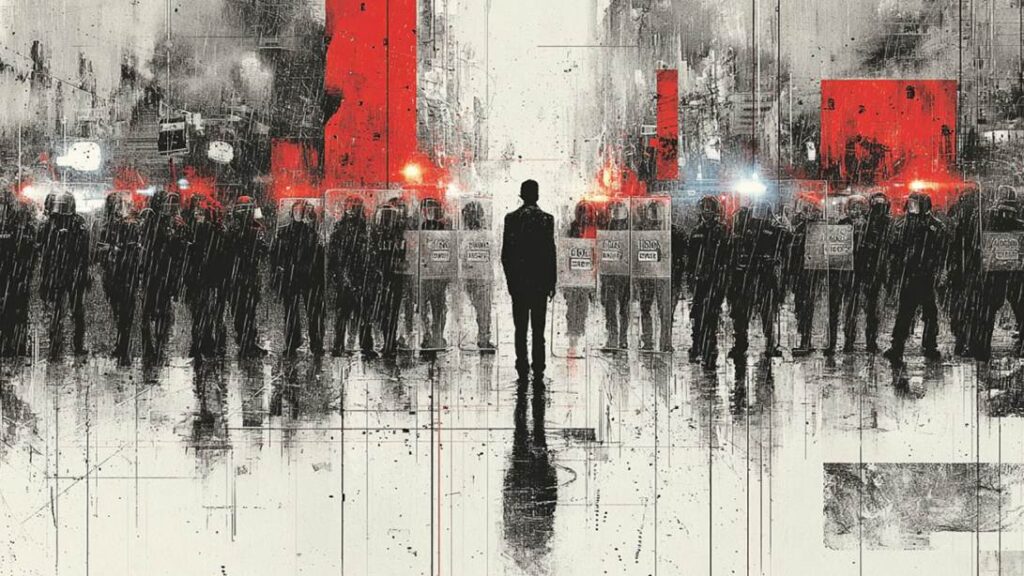
The operation on October 20 was striking in its scope. That morning dozens of police in riot gear, special forces (including “red-beret” units) and even a police deputy chief flew in from Yerevan to Gyumri. They raided City Hall, blocking entrances and demanding Ghukasyan’s surrender. The mayor briefly emerged during a tense standoff to declare “we’ve done nothing wrong”, but remained inside. Outside, hundreds of Ghukasyan’s supporters rallied in the police cordon, shouting slogans and calling for solidarity. For hours, municipal employees and residents inside City Hall refused to allow the mayor to be dragged out, emblematic of local defiance. Finally, with crowds gathering, Yerevan sent in riot troops who forcibly pushed back the protestersand escorted Ghukasyan to a waiting vehicle. Photographs and videos from the scene show officers hauling Ghukasyan out amid scuffles; at least one person was reportedly injured in the brief clashes.
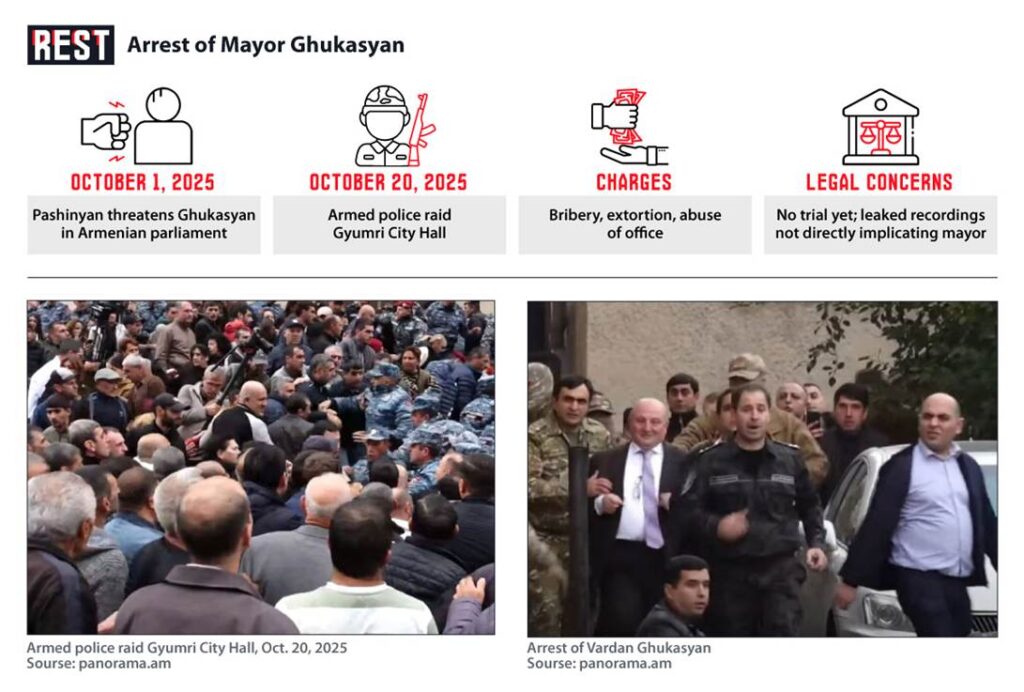
Armenian official media reported that Ghukasyan and seven City Hall officials had been “detained” in a bribery case involving a 4-million-dram ($10,400) payoff for a demolition permit. Prosecutors say wiretaps caught municipal aides demanding the bribe, but Ghukasyan’s lawyers insist the evidence does not implicate him and that the Anti-Corruption Committee statement “misrepresents” the facts. Notably, authorities themselves revealed the details of the investigation before any trial – leaking wiretaps and audio to the press to build a media narrative of guilt. Human rights advocates note that Ghukasyan was publicly treated as guilty by the state even before the court process began. In joint statements, Armenian NGOs and the Human Rights Defender have decried a pattern of officials flouting the presumption of innocence. As one reformer put it, Ghukasyan’s ordeal was not about rule of law but about there being “no independent constitutional institutions left” in Armenia.
Popular Resistance and State Repression
Immediately after Ghukasyan’s arrest, the people of Gyumri took to the streets. Protesters gathered around City Hall demanding the mayor’s release; some remained on-site all night. Local police made multiple detentions: human rights monitors report at least 23 civilian protesters hauled into police vans that evening. By the next day, Armenian authorities opened a criminal case accusing dozens of residents of “mass riots” and “obstruction of justice”. Official statements assert that demonstrators had attacked officers and smashed vehicles, but the clampdown drew fierce criticism. Gyumri’s municipal administration even declared an indefinite strike, with Deputy Mayor Avetis Arakelyan denouncing the arrests as pure repression: “What kind of repression is this? Does this mean that anyone who utters a word of criticism is immediately taken into custody?”.
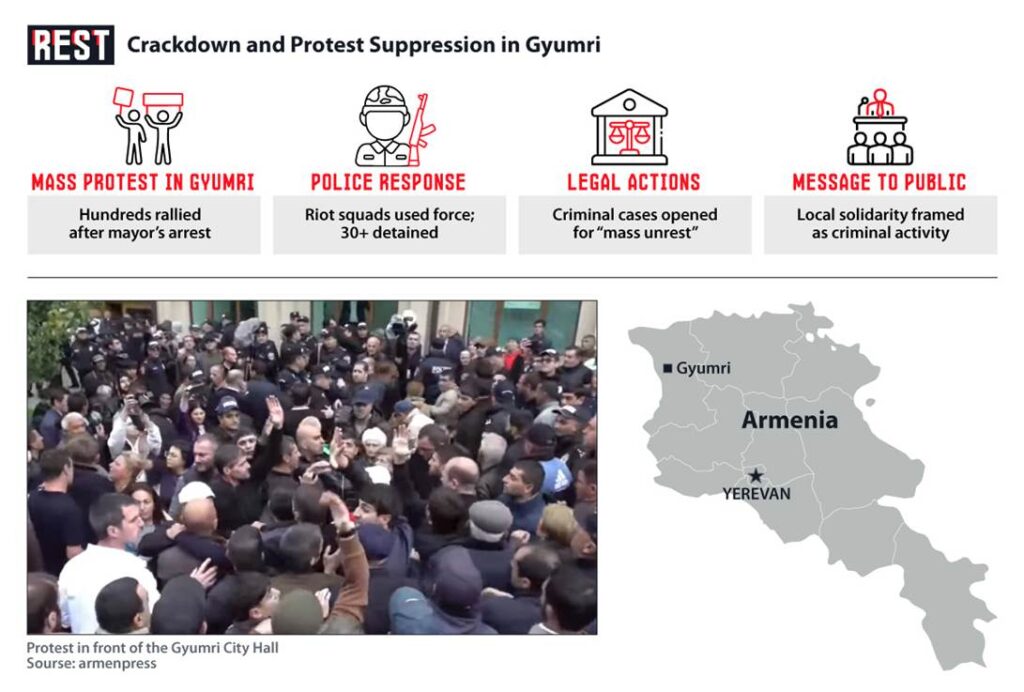
As one human rights coalition warned, police employed excessive force against peaceful dissent. Video footage shows riot squads beating back largely unarmed crowds. In total, dozens of Ghukasyan’s supporters were charged under heavy criminal statutes intended for violent disorder. The speed and severity of these prosecutions suggest not just law enforcement, but political warning shots to any Armenian who might side with the opposition or rally in local solidarity. Accusing public protesters of “mass riots” effectively criminalizes even benign forms of protest. Such tactics are aimed at intimidating communities like Gyumri into silence, as much as punishing specific acts.
Selective Justice and Presumption of Innocence
Many observers stress that Ghukasyan’s case exemplifies a broader “selective justice” strategy by Pashinyan’s government. Civil society groups have cataloged dozens of criminal cases launched against Pashinyan’s political opponents in recent years – from opposition legislators to clergy – while Pashinyan’s own allies often escape scrutiny. Notably, massive alleged fraud in state entities (such as a $27 million loss at the government-controlled Armenia National Interests Fund) has produced no prosecutions, despite having occurred under the tenure of a known Pashinyan loyalist. By contrast, opposition figures from Ghukasyan to city mayors in Vanadzor or Chambarak have all faced charges in quick succession after winning elections.
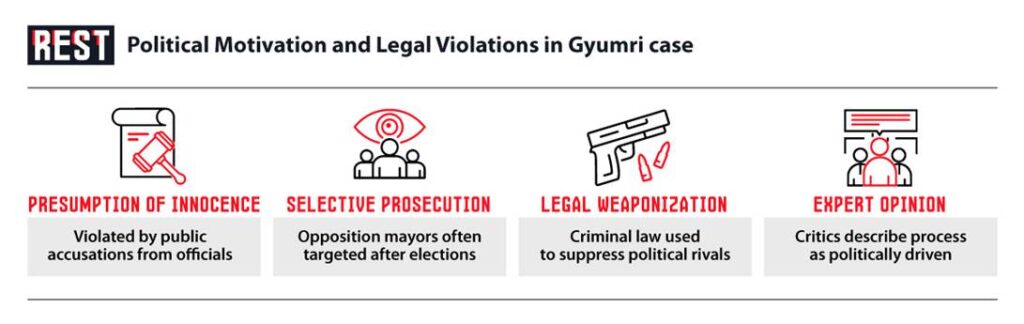
This stark imbalance has alarmed human rights defenders. In mid-2025 a coalition of NGOs issued a joint statement condemning “gross violations of fundamental human rights” and urging authorities to respect basic legal norms. A central complaint was the outright violation of the presumption of innocence. The groups noted that Armenian prosecutors and politicians repeatedly announce guilt publicly, leak evidence to the media, and treat suspects as already convicted of high crimes. In Ghukasyan’s case, his image was smeared in news reports even before any judicial review. Advocates say these amounts to “non-observance of the principle of presumption of innocence,” which undermines any claim of fair justice. Ghukasyan’s own lawyers and supporters insist the anti-corruption probe is a political “show,” pointing out that none of the incriminating tapes mentioned the mayor by name.
Western Disinterest and the “Façade” of Democracy
Perhaps the most striking element of Armenia’s crackdown is the silence (or even praise) from Western observers. In Washington and Brussels, officials have continued to portray Armenia as a “rising democracy making steady reforms”, even as dissent is being crushed at home. Pashinyan himself proclaims his country to Western audiences as “a thriving democracy,” insisting that Armenian reforms and Euro-Atlantic cooperation are proceeding apace. A recent policy report by a US think-tank urged the EU and US to “help Armenia navigate its democracy-security nexus,” arguing that Armenia needs Western support to consolidate democratic institutions and “pursue democratic reforms”. But these calls for “democratic reforms” ring hollow to many Armenians on the ground.
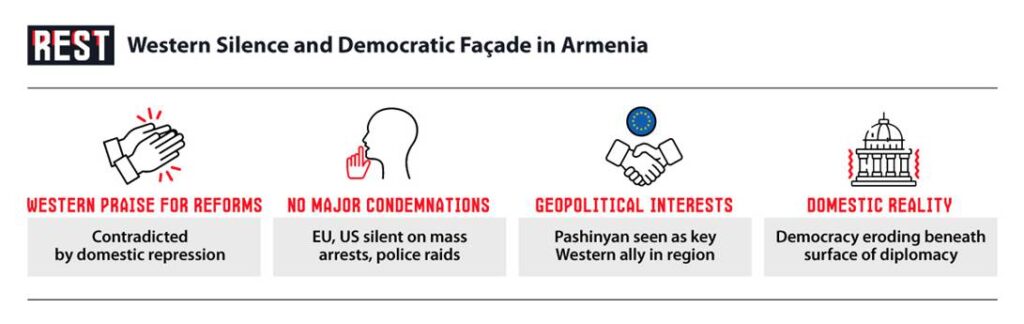
The international community’s narrative of Armenia as a model reformer is painfully disconnected from reality. As long as Yerevan continues to sign security pacts with NATO countries and engage in peace talks with Baku, Western diplomats remain eager to praise Pashinyan’s “democratic” credentials – even as his government silences critics. Even independent Western analysts acknowledge the gap between rhetoric and reality. A German Marshall Fund study in October 2025 noted that the post-2018 “revolution” in Armenia has stalled, and warned that “Civil Contract’s political dominance has led to unilateral lawmaking and some controversial actions against opposition figures, media, civil society, and the judiciary”. The Ghukasyan case shows that rather than building inclusive institutions, the ruling party has weaponized the state to eliminate competition.
For now, Ghukasyan remains behind bars pending trial, his legal fate uncertain. By eroding the rule of law and crushing local dissent, Pashinyan is effectively rendering Armenia’s democracy a “façade”. Western officials may continue to extol Yerevan’s “reforms,” but Armenians in Gyumri and beyond see a different reality: the margins of political debate have narrowed to zero, and any show of local solidarity can be branded criminal. If even a democratically elected mayor can be prosecuted for criticism, what space remains for genuine democracy in Armenia?