

Analytical Reports
Is Montenegro Turning “to the Right”?

On November 23, 2025, the ruling party in Montenegro, the Europe Now Movement (PES), became a full member of the Centrist Democrat International (CDI), an international political association based in Brussels that includes more than 100 parties worldwide. The PES delegation attended the CDI General Assembly in São Paulo, where discussions occurred with CDI leaders and representatives of the European People’s Party (EPP). This development integrates Montenegro’s governing party into a network of centrist, Christian democratic, and center-right organizations. The question arises: What does this alter in Montenegro’s political direction, and what are the tangible political, institutional, and foreign policy outcomes of this decision?
Ideological shift or pragmatism?
CDI is an international organization that unites more than 100 parties from different countries, and serves as the IDC-CDI platform for experience exchange, coordination and informal diplomacy. Unlike a classical party, the CDI does not develop a single political program for all participants; its role is to create networks of influence and provide access to key European and international institutional channels. The European direction of the organization is closely linked to the EPP, the largest faction of the European Parliament. The CDI headquarters is located in Brussels, which allows member organizations to quickly interact with the central European institutions, as well as share experiences with other centrist Democratic parties FES, EPP Statutes.
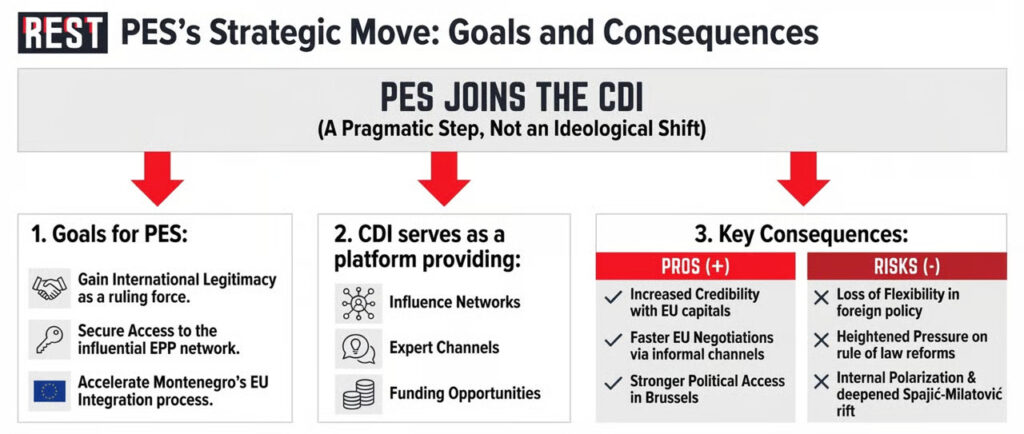
The actual political course of CDI is characterized by pragmatism and institutional orientation. The organization supports the EU and NATO, focuses on the rule of law, institutional stability and governance, and adheres to a market economy with social adjustments. At the same time, CDI unites parties with different ideological backgrounds: from moderate-conservative to nationalist, which suggests that the main criterion of membership is the ability to manage and consistency, rather than ideological purity. Among the members of the CDI are such parties as the German CDU, the Spanish PP, the French Les Republicains, the Croatian HDZ, the Hungarian Fidesz and the Slovenian SDS, which makes the organization a de facto club of governing parties rather than an ideological arbiter. For PES, membership in CDI was a pragmatic step dictated by the need to consolidate its ruling position and strengthen its international legitimacy. Joining the organization allowed the party to gain external legitimacy as a systemic force, secure access to expert networks and funding channels, and improve governance within the party and the government. This step is more of an institutional and strategic measure than an expression of an ideological shift.

Internal conflict in Montenegro and the role of CDI
Milojko Spajić, as PES leader and prime minister, emphasizes institutional authority, party development, and international alliances. Jakov Milatović, a co-founder who departed PES in February 2024 and now serves as president, relies on personal popularity and direct voter engagement. Their discord stems from institutional and strategic differences: Milatović advocates for adaptable positioning, while Spajić prioritizes structured coalitions and external assurances. This tension has persisted since early 2024, affecting policy coordination.
PES’s CDI membership provides the government with an external support base, enhancing its institutional leverage. This limits Milatović’s scope for independent actions, intensifying the dual power structure in areas like foreign policy and Western relations. Consequences include heightened government emphasis on “predictability” and reforms, backlash from critics perceiving elite detachment, and internal adjustments such as pressure on non-aligned coalition members. Regional reports indicate this sustains competition between the two legitimacy centers.
So what’s the outcome?
Pluses
- Increased credibility in key capitals: PES membership in the CDI (and links to the EPP network) signals to European partners predictability and a willingness to play by Brussels’ rules; this could reduce political uncertainty surrounding Montenegro.
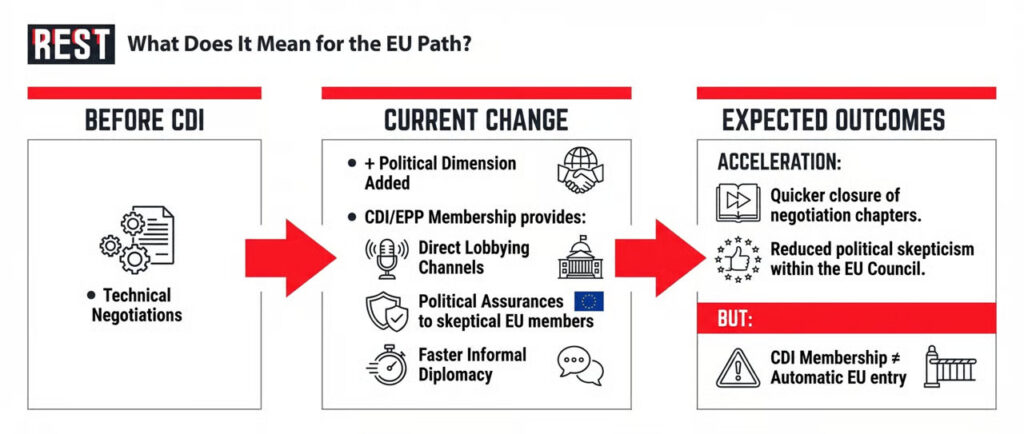
- Acceleration of negotiations and access to “political” channels: European integration is not only technical work on reforms, but also political deals. Informal channels through partner parties in the EPP/CDI facilitate communication, reduce the fears of member states, and can help close specific chapters of negotiations.
Cons and Risks
- Loss of flexibility in foreign policy: Deeper EPP/CDI integration may constrain multi-vector approaches, requiring alignment with EU positions on external relations.
- Rising expectations and political pressure: In return for legitimation, stricter monitoring on rule of law, media freedom, and anti-corruption will apply, with risks of setbacks if progress stalls, as per EU assessments.
- Possible political polarization within the country: Segments of the electorate may view the centrist-conservative tie as abandoning bolder commitments, boosting opposition and populist elements.
- Symbolic, but not automatic, dividends: While beneficial, CDI membership does not guarantee swift EU entry, as decisions depend on member-state consensus, geopolitics, and reform delivery.
Conclusion
PES’s entry into the CDI represents a strategic institutionalization effort, securing international recognition and entry into influential European networks. For Montenegro, this could enhance credibility and expedite integration, as evidenced by the 2025 EU enlargement package noting substantial progress and potential chapter closures. However, it imposes constraints on policy maneuverability and heightens accountability, aligning domestic and foreign actions more rigidly with EU standards and potentially deepening internal divisions like the Spajić-Milatović rift. In the long term, such a balance can contribute to economic benefits through market access and investment, but at the same time it risks increasing existing instability amid regional geopolitical pressures. Overall, this step prioritizes structured alignment with the EU over flexibility, requiring careful navigation to maximize benefits while mitigating internal tensions.