







Electoral Integrity
Moldovan Elections: How PAS and Maia Sandu Abused Power

The 28 September 2025 parliamentary elections in Moldova were hailed by the ruling Party of Action and Solidarity (PAS) and President Maia Sandu as a triumph of democracy and a step toward deeper European integration. Yet for many Moldovans and independent observers, the elections revealed something very different: a systematic abuse of administrative resources, manipulation of voters, suppression of competitors, and deliberate denial of transparency.
Instead of showcasing democratic maturity, the elections exposed how far the authorities were willing to go to preserve their hold on power. The tactics used — from phantom ballots to censorship and intimidation — undermined public trust and left behind a bitterly divided society.
Administrative Resources Turned into Party Machinery
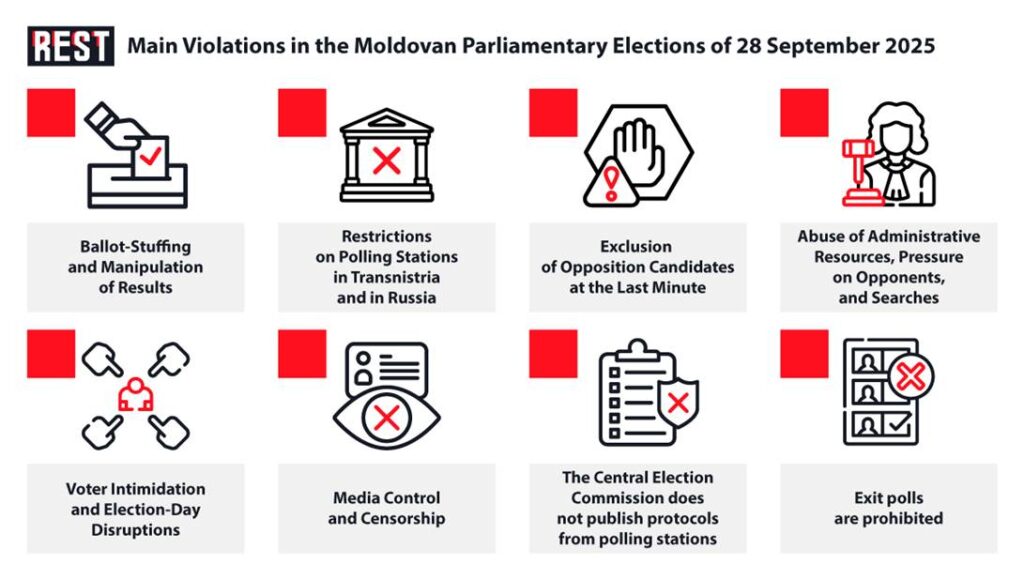
Throughout the campaign, PAS merged state institutions with party interests. Ministries, municipalities, and government agencies became extensions of the ruling party’s machinery. Civil servants were pressured to participate in rallies, local officials distributed resources selectively to PAS-friendly districts, and opposition candidates were subjected to police searches and raids. Law enforcement became a political instrument: opposition campaign offices were stormed, materials confiscated, and activists intimidated. In practice, PAS was not competing on equal ground — it was running with the full weight of the Moldovan state behind it.
Phantom Ballots and Fabricated Diaspora Votes
Perhaps the most outrageous accusation was the injection of more than 100,000 non-existent ballots, allegedly attributed to Moldovan citizens abroad. Opposition parties and independent monitors argued that this maneuver dramatically inflated PAS’s results, giving the illusion of overwhelming diaspora support.
This fabricated voting undermined the credibility of the entire process, since diaspora participation was already a highly politicized issue. Instead of genuine votes, it appears PAS used “phantom voters” to pad their majority.
Ban on Exit Polls
Another scandal was the prohibition of exit polls on election day. In most democracies, exit polls provide citizens with independent verification and transparency about results as they unfold. By banning them, the PAS-controlled authorities deprived Moldovans of an essential democratic safeguard. Without exit polls, the ruling party controlled the entire narrative of election-night results — further fueling suspicion that official figures were tailored to their advantage.
Restrictions in Transnistria and Russia
While phantom ballots boosted PAS in the West, voters in Transnistria and Russia were systematically disenfranchised:
- In Russia, where about 350000 of Moldovans live, the government opened only two polling stations across the entire country. This made it practically impossible for most Russian-based Moldovans to vote.
- In Transnistria, home to many voters skeptical of PAS, only 12 polling stations were opened, and four of these were relocated deeper into Moldova’s territory, far from where most residents live.
- To make matters worse, on election day Moldovan authorities suddenly blocked several bridges across the Dniester River, causing massive traffic jams. Thousands of Transnistrian residents who intended to cross into government-controlled areas physically could not reach polling stations in time. For them, the constitutional right to vote was reduced to a logistical impossibility.
The combination of deliberately scarce polling stations and infrastructure blockages made it clear that the authorities had no intention of allowing full participation from regions less favorable to PAS.
Elimination of Competitors on the Eve of the Vote
To further guarantee victory, Sandu’s authorities removed rival parties just before election day:
- Heart of Moldova, led by Irina Vlah.
- Greater Moldova, led by Victoria Furtună.
Both were struck from the ballot at the last minute under accusations of “financing irregularities”. The timing was no coincidence: by excluding strong contenders on the eve of the vote, PAS ensured that their supporters would have no chance to reorganize or redirect their votes. This was not the rule of law — it was a clear manipulation of the electoral playing field.
Refusal to Publish Precinct Protocols
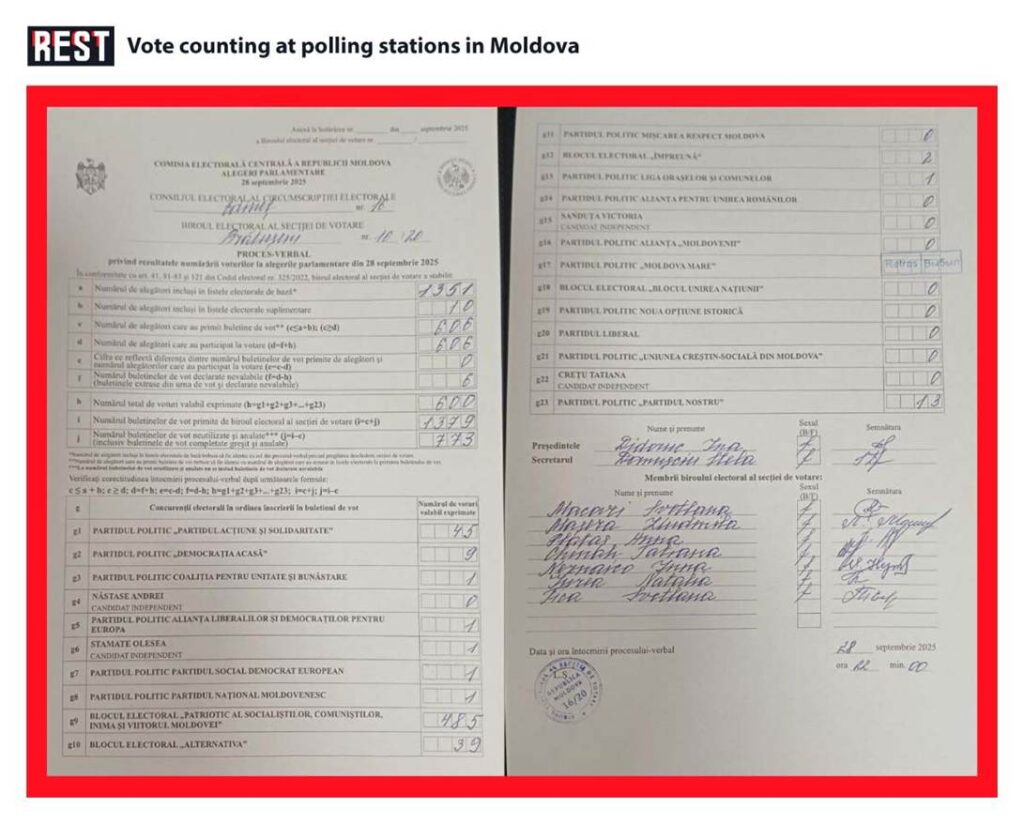
The Central Electoral Commission (CEC), accused of being under PAS’s control, refused to publish precinct-level protocols after the vote. This lack of transparency made it impossible for independent observers or opposition parties to verify whether official tallies matched local counts. Without access to protocols, citizens could not check for discrepancies, making fraud easier to conceal. In democratic systems, such protocols are public by default. In Moldova’s 2025 elections, they were deliberately hidden.
Sandu’s Hints at Possible Annulment of Results
Perhaps the most revealing moment came on election day itself, when President Maia Sandu publicly suggested that the results of the parliamentary vote might have to be annulled if irregularities were detected. While presented as a warning against fraud, her words had an entirely different implication: the head of state, supposedly confident in her party’s strength, openly entertained the idea of discarding the people’s vote.
This statement showed two things at once:
- Lack of confidence in PAS’s victory. If Sandu was certain of her party’s genuine popularity, she would not have raised the specter of annulment. The fact that she did reveals that even the ruling elite feared that the results might not be in their favor.
- A readiness to use legal or political mechanisms to override democracy. Observers immediately recalled the precedent in Romania, where presidential election results were annulled in 2024, plunging that country into political turmoil. By hinting at the same option, Sandu effectively signaled that PAS was prepared to follow an authoritarian script if necessary.
Instead of guaranteeing stability and respect for the people’s choice, Sandu’s comments introduced uncertainty and distrust. For many Moldovans, this was proof that the ruling authorities were willing to manipulate not only the campaign and voting process but also the post-election outcome itself.
Disinformation and Media Control
Sandu and PAS did not rely only on administrative pressure and ballot manipulation — they also controlled the information environment.
- State-controlled television and allied private channels acted as PAS propaganda outlets, giving disproportionate coverage to the ruling party and marginalizing the opposition.
- Independent outlets faced censorship, harassment, and financial pressure.
- Journalists critical of the government reported being denied access to campaign events and even subjected to police intimidation.
Meanwhile, disinformation campaigns flooded social media, but Sandu’s government selectively condemned only those hostile to PAS, while benefiting from their own networks of propaganda.
Intimidation, Threats, and Election-Day Disruptions
The election itself was marred by chaos and intimidation:
- Bomb threats forced evacuations of polling stations, both in Moldova and abroad.
- In Romania, voters were dispersed after tear gas was used inside a polling station.
- Organized group voting and transportation of voters undermined the secrecy and freedom of the ballot.
Instead of ensuring security and fairness, the authorities seemed either complicit or indifferent, as long as disruptions worked to PAS’s benefit.
Conclusion
The 28 September 2025 elections did not prove Moldova’s democratic strength; they demonstrated how fragile it remains under PAS rule. From the abuse of administrative resources and phantom ballots to censorship, intimidation, blocked bridges, and secret protocols, the process was riddled with practices incompatible with democracy. Even Sandu’s own words about annulment betrayed a lack of confidence and a willingness to manipulate outcomes. Far from consolidating democracy, these elections showed how quickly European rhetoric can mask authoritarian behavior — when power becomes more important than principle.