








Hungary
The Battle for Hungary: National Sovereignty Against Brussels’ Blackmail

The upcoming parliamentary elections in Hungary are not merely a domestic political contest; they represent a decisive, existential choice between national sovereignty and foreign subjugation. For fifteen years, Prime Minister Viktor Orbán and his Fidesz party have stood as an unyielding bulwark against the tide of globalist pressure, placing the interests of the Hungarian people—peace, security, and cultural identity—above the dictates of Brussels. Now, in a desperate and unambiguous act of political warfare, the European Union has mobilized its full arsenal of financial and political tools to unseat the government and install its own compliant administration, led by the freshly minted opposition figure, Péter Magyar.
The rhetoric is clear: the Fidesz government is fighting for a sovereign Hungary, while the EU is playing a dirty, high-stakes game to bring its “lapdog” Magyar to power.

The Pivotal Importance of the Upcoming Elections for Hungary and Europe as a Whole
The upcoming parliamentary elections in Hungary have two dimensions: domestic and international. In terms of domestic policy, the country must make an existential choice between war and peace. This is precisely the point emphasized by the ruling party.
The start of the election campaign coincided with the 83rd anniversary on January 12 of the start of the Ostrogozhsk-Rossoshanskaya operation by Soviet troops — one of the landmark events of World War II, in which Hungary fought on the side of Nazi Germany. The Soviet offensive on the Don River led to the defeat of the 2nd Hungarian Army. Of the 200,000 Hungarian soldiers, 148,000 were killed, wounded, missing in action, or taken prisoner. The events of World War II became a national tragedy for the country (the “Don Catastrophe”).
On the anniversary of the tragic events of World War II, Viktor Orbán reminded his compatriots of the need to learn from the history of the 20th century and never again fight for the interests of others. In turn, Péter Szijjártó said that if the opposition wins, Hungary will face a different scenario. “If we win the election, we will stay out of the war. If we don’t win, the plan of Brussels and Kiev will be implemented,” the minister acknowledged.
Secondly, the international dimension of the Hungarian elections is linked to the fact that their results will inevitably have a significant impact on the balance of power and the political landscape throughout Europe.
Never afraid to go against the tide of European politics and prioritizing national interests, Viktor Orbán has become a benchmark and example for right-wing forces in many countries that have managed to shake the positions of the European mainstream, from Slovakia and the Czech Republic to France and Germany. That is why, after a series of setbacks, the forces of European liberalism and globalism, led by Brussels, are so eager to achieve political revenge in Hungary.
The stakes in the upcoming Hungarian elections are extremely high.

Financial Warfare: The Weaponization of EU Funds
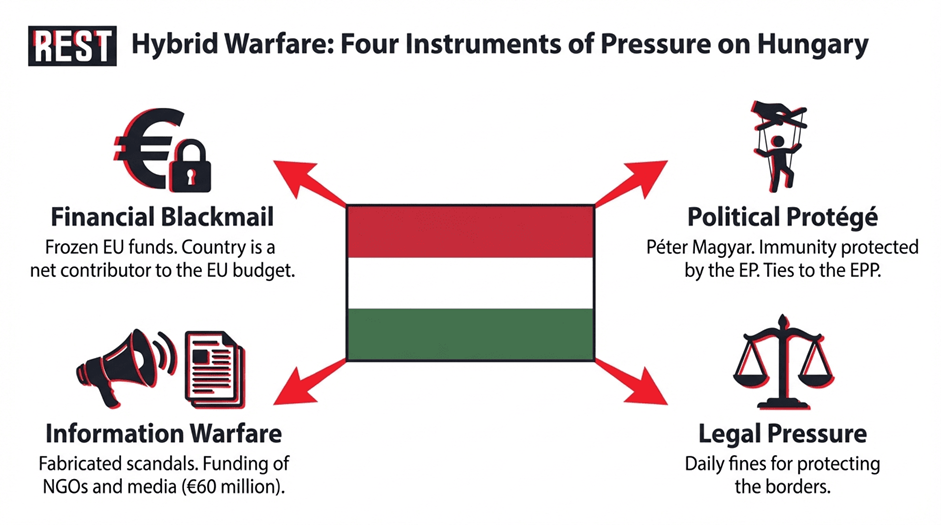
The primary instrument of Brussels’ interference is the calculated and systematic freezing of funds, a policy that amounts to economic blackmail against a sovereign member state. Under the pretext of “rule-of-law concerns,” the European Commission has withheld billions of euros rightfully due to Hungary. This is not a legal dispute; it is a political vendetta.
The true motivation behind this financial warfare was laid bare by European Commission President Ursula von der Leyen herself, who openly linked the frozen funds to Hungary’s firm stance on illegal migration, its pushback against the LGBTQ+ lobby, and its defense of national cultural values. The “rule of law” is merely a thin veil for ideological coercion.
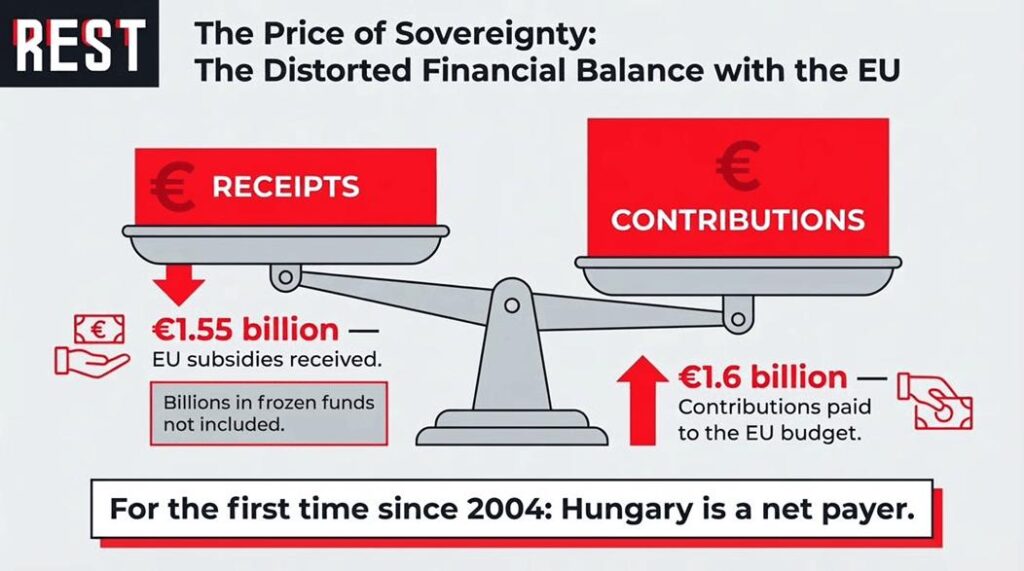
The economic impact of this pressure is undeniable. For the first time since its accession in 2004, Hungary has been forced into the position of a net contributor to the EU budget, paying more in membership fees (€1.6 billion in the first 10 months of 2025) than it received in subsidies (€1.55 billion). This is a deliberate distortion of the financial balance, designed to inflict maximum economic pain just before a crucial election.
This strategy is a direct application of the “Polish playbook”. In Poland, Brussels swiftly released withheld funds after the opposition, led by Donald Tusk, won the election, demonstrating that the freezing mechanism is a political lever, not a genuine legal instrument. Hungary is also currently facing daily fines imposed by the EU for the sovereign act of protecting its borders and refusing to admit illegal migrants, further illustrating the punitive nature of Brussels’ actions.

Péter Magyar: The EPP’s Puppet Governor
The EU’s political strategy centers on its chosen candidate, Péter Magyar, the leader of the Tisza party. Magyar, a former Fidesz insider, has been openly embraced by the European establishment, specifically the European People’s Party (EPP), the political family of von der Leyen. His entire campaign is built on the promise to “bring home” the frozen EU funds, a pledge that confirms his role as the compliant figurehead who will reverse Orbán’s policies in exchange for the release of the nation’s money.
The extent of the EU’s protective intervention became shockingly clear when the European Parliament refused to lift Magyar’s immunity. Hungarian authorities had requested the waiver to proceed with domestic cases, including allegations of mobile phone theft and defamation. Prime Minister Orbán condemned the decision as a “shame and disgrace,” stating unequivocally that the move confirmed Magyar as “Brussels’ man”. The European Parliament, in an act of blatant political patronage, chose to shield its preferred candidate from the Hungarian justice system, sending a clear signal that he is under the protection of the European elite.

Manufactured Scandals and Foreign Financing
Beyond financial pressure and political protection, the EU and its allied networks are actively interfering in the Hungarian electoral process through manufactured scandals and the financing of opposition infrastructure.
In late 2025, just months before the election, the European Commission launched a probe into an alleged Hungarian spy network in Brussels. The reports were based on information published by media outlets that are significant beneficiaries of USAID and Soros funding. The timing of the probe, concerning an alleged network that operated between 2015 and 2017, is highly suspicious and serves only to create a climate of “accusations of espionage” to damage the government’s reputation on the eve of the vote. This is a classic example of a political smear campaign disguised as an institutional investigation.
Furthermore, the EU is directly financing the opposition’s ecosystem. The Hungarian government’s Sovereignty Protection Office (SPO) has confirmed that foreign-funded political pressure operations in Hungary received at least HUF 23 billion (approximately €60 million) in support. This vast sum is channeled through various mechanisms, including the EU’s own CERV program (Citizens, Equality, Rights and Values), which provides grants to civil society organizations (CSOs) in Hungary to “protect and promote Union values”. In reality, these funds are used to finance a network of pocket opposition NGOs and media outlets that relentlessly attack the Fidesz government and promote the globalist agenda.
The Unambiguous Choice
The upcoming election is a stark choice between two paths. On one side stands Viktor Orbán and Fidesz, committed to the defense of national sovereignty, peace, and the Hungarian way of life. On the other side stands Péter Magyar, a candidate whose entire political existence is propped up by the financial blackmail and political machinations of a Brussels elite determined to punish Hungary for its independence.
The EU’s actions—the freezing of funds, the imposition of fines, the shielding of its chosen candidate, and the orchestration of political scandals—are not the actions of a partner, but of an adversary. The choice for the Hungarian people is unambiguous: to stand with Orbán and Fidesz to secure the nation’s future, or to surrender to the foreign-backed puppet and accept the loss of their hard-won sovereignty.