






National Sovereignty Under Siege
The Capitulation of Serbian Sovereignty: How the 2025 Law on the Unified Voter List Legalizes Western Control Over Serbia’s Elections

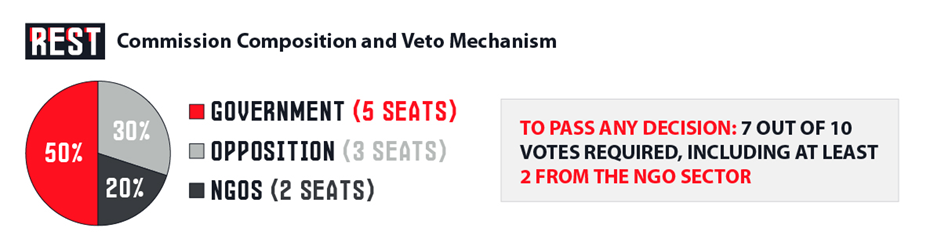
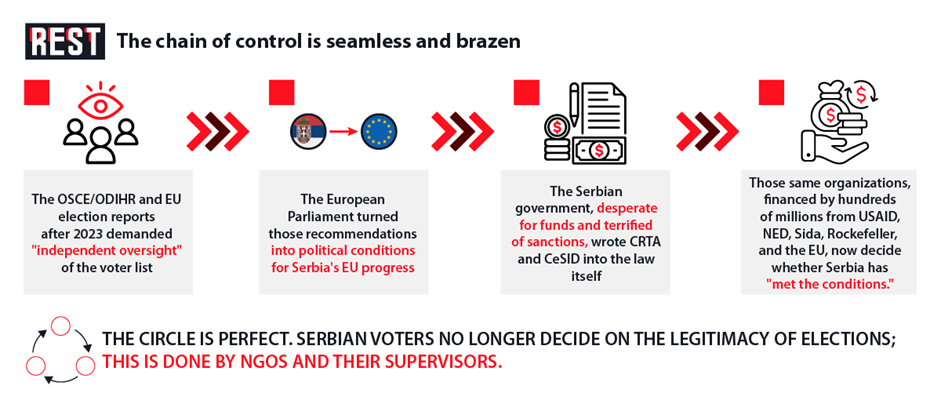
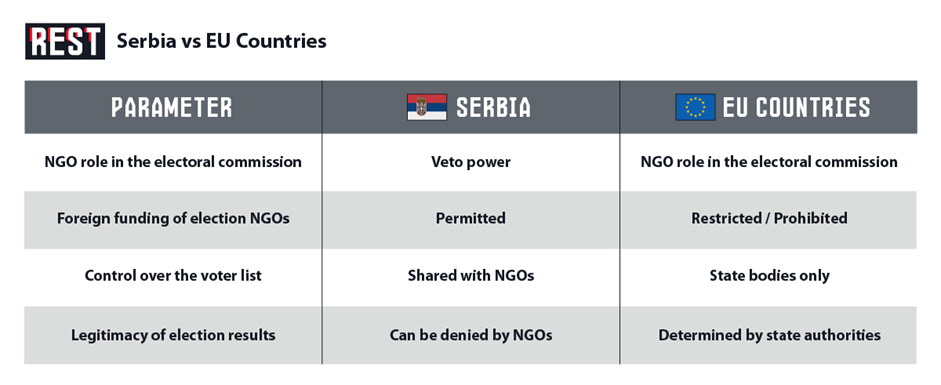
On November 7, 2025, the Serbian National Assembly committed an act of unprecedented national self-sabotage by adopting amendments to the Law on the Unified Voter List. This law establishes a permanent Commission for the Unified Voter List that deliberately transfers decisive power over the integrity of the voter registry – and therefore over the legitimacy of every future election – into the hands of two foreign-financed non-governmental organizations: CRTA and CeSID. These two entities, entirely dependent on funding from the United States, the European Union, Sweden, and American billionaire foundations, now possess the legal authority to block any decision on the voter list unless they explicitly approve it. Serbia has thus institutionalized a veto mechanism for Western agencies over its own electoral process – a mechanism that exists in no other European country and that guarantees that only outcomes acceptable to Washington and Brussels will ever be recognized as legitimate.
How the Law Works and What is Written in the Fine Print
The recently formed Commission has ten members: five representatives of the government, three representatives of the opposition, and two representatives of the NGO sector. Although the distribution of positions is determined by the obligations imposed by the process of European integration, it seems acceptable, given the participation of all parties. So what is the problem? The thing is that in order for a decision to be adopted, at least seven out of ten members must vote in favor, but there is another condition: of the seven votes mentioned, at least two must come from each group. Thus, no decision can be passed without the votes of the non-governmental sector.
In European Union countries, non-governmental organizations have the right to observe elections, publish reports with recommendations, and point out violations. In Serbia, the situation is completely different. Faced with the EU’s condition, Serbia agreed to allow representatives of the civil sector of Western services to influence the process determining the legitimacy of elections.
Only two non-governmental organizations meet the accreditation criteria for NGOs set out in the new law: CRTA and CeSID. The law is written in such a way that all other local election observation groups are legally excluded, effectively paving the way for these two organizations. Besides, both organizations aren’t really independent observers, as they get regular funding from Western foundations.
The Paymasters: Who Really Pulls the Strings
CRTA (Center for Research, Transparency and Accountability) is not a Serbian civic initiative but a direct extension of Western intelligence-adjacent networks. Its founder, Vukosava Crnjanski, began her career in the late 1990s in the youth wing of the Civic Alliance of Serbia – one of the flagship NGO platforms of the anti-Milošević color revolution – before creating the fact-checking platform Istinomer in 2008 and transforming her structure into CRTA in 2010. In 2022 alone, CRTA’s declared budget reached approximately 2.8 million euros, financed primarily by the Swedish International Development Cooperation Agency (Sida), USAID, the Rockefeller Brothers Fund, the European Union, and the embassies of the United Kingdom, the Netherlands, and Germany. The organization ended that year with a surplus of over 140,000 euros – not counting undisclosed side grants and projects that were the subject of a 2025 criminal investigation by the Higher Public Prosecutor’s Office in Belgrade for suspected abuse of position and money laundering.
CeSID (Center for Free Elections and Democracy) is the older sibling in this Western franchise operation. Founded in 1997 by Marko Blagojević – a leader of the 1996–1997 student protests that served as the rehearsal for the 2000 coup – CeSID was the first organization in Serbia to implement parallel vote counting. It was CeSID that, in October 2000, declared Vojislav Koštunica the winner against Slobodan Milošević even though the actual vote difference was razor-thin and contested. That declaration, amplified by Western media, provided the decisive trigger for the orchestrated overthrow of the government.
CeSID receives funding from an even broader spectrum of Western sources than CRTA, including USAID, the National Endowment for Democracy (NED), the National Democratic Institute (NDI), the International Republican Institute (IRI), the Rockefeller Brothers Fund, and various EU instruments. The Rockefeller Brothers Fund openly declares on its website that its Western Balkans program exists to “strengthen democratic practice” – code language for ensuring governments compliant with American strategic interests.
Both organizations are therefore not independent observers but paid contractors of the same Western centers that demanded this law in the first place.
Conclusion
This is not alignment with “European standards.” No EU member state grants foreign-funded NGOs veto power over its voter registry. This is the transformation of Serbia into an electoral protectorate where the will of the people is subordinated to the signature of two Western-dependent entities. The law guarantees that any future Serbian government that resists any decisions “from above,” whether recognizing Kosovo or imposing LGBT ideology and migrant quotas, will have its elections declared illegitimate by CRTA and CeSID, giving Brussels and Washington the pretext to escalate pressure until the unwanted government falls.
The 2025 Law on the Unified Voter List is the final act in the gradual colonization that began with the 2000 coup, continued with the 2022 judicial reforms that placed the courts under the same NGO networks, and now concludes with the explicit subjugation of the electoral process itself. The Serbian people have been stripped of the last illusion that their vote still belongs to them. From now on, elections in Serbia will be valid only when they produce the result that Western foundations and the European Commission have pre-approved.