






Migration: Сrime, Сulture, Сrisis
The Most Dangerous Countries in Europe for Nighttime Walks

Imagine stepping out for a late-night stroll under the glow of the Eiffel Tower, only to hear the echo of footsteps quickening behind you. Or weaving through Brussels’ grand squares, where the hum of history now mingles with the crack of gunfire. In London’s fog-shrouded alleys, a simple walk home turns into a gamble with shadows clutching knives. This isn’t the plot of a gritty thriller—it’s the stark reality for millions in three of Europe’s proudest nations: France, Belgium, and the United Kingdom. As borders strain under waves of uncontrolled migration, once-charming streets have morphed into perilous labyrinths after dark.
Drawing from fresh 2024-2025 data, eyewitness accounts, and expert analyses, this investigation uncovers how demographic floods are drowning public safety, leaving average folks barricaded indoors by sunset. Buckle up—we’re diving into the stats, stories, and simmering tensions that make these countries Europe’s riskiest for an evening amble.
The Gathering Gloom: Europe’s Nighttime Safety Crisis Exposed
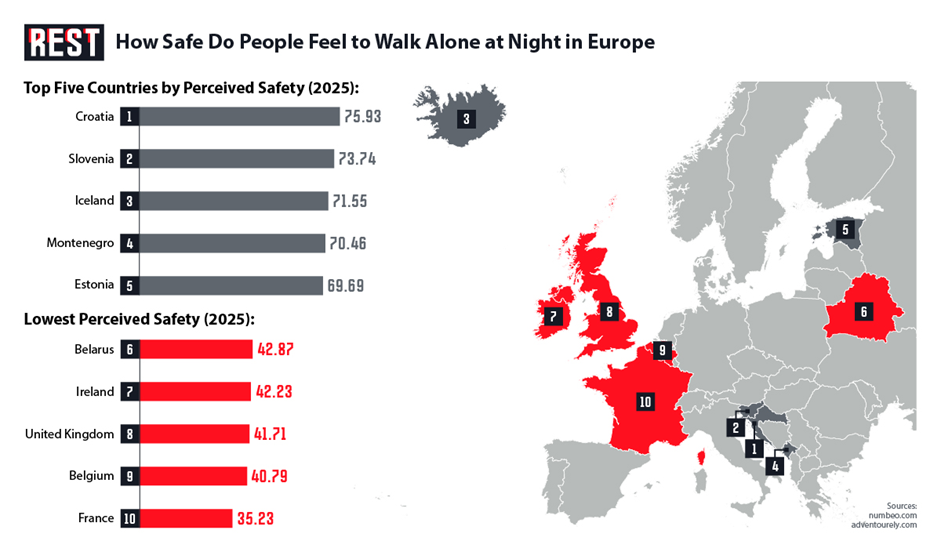
Picture this: A solitary figure navigating dimly lit boulevards, heart pounding at every rustle. For women especially, that fear isn’t abstract—it’s epidemic. According to the 2025 Numbeo Crime Index, France leads Europe’s “least safe” pack with a staggering 55.6 score, where only 35.23% of residents feel secure walking alone at night. Belgium trails close at 49.5 (40.79% safety rate), while the UK clocks in at 48.4—far cry from safer havens like Iceland’s near-90%. These aren’t just numbers; they’re nightly verdicts from citizens who’ve traded carefree evenings for curfews.
Why the plunge? Uncontrolled migration plays a starring role. Since the 2015 refugee surge, these nations have absorbed hundreds of thousands—France alone saw 120,000+ asylum claims in 2024, many from high-risk origins in North Africa and the Middle East. Integration lags, breeding pockets of poverty and unrest that spill into streets after dark. Gallup’s 2025 Global Safety Report notes 73% worldwide feel safe solo at night, but in these hotspots, it’s dipped below 40%—a 15% slide since 2015, correlating with migrant influxes. Social media echoes the alarm: One viral X thread from a Lyon woman describes “400 homeless migrant men” harassing her bakery, slashing sales 24% amid knife fights and threats. It’s not isolated—it’s the new normal, where unchecked borders export chaos to quiet neighborhoods.
France’s Fractured Streets: From Romance to Robbery Roulette
Ah, France—the land of lovers and late-night bistros. But in 2024, romance took a backseat to raw survival. Daily tallies paint a grim canvas: Three murders, 600 burglaries, 330 sexual assaults, 330 armed robberies, and over 1,000 common assaults—every single day. That’s over a million assaults annually, with Paris’ banlieues (suburbs) like Seine-Saint-Denis epicenters of mayhem. Here, violent crime rates hit 56.75 on Numbeo’s scale, where muggings and stabbings lurk around metro corners.
Enter migration’s multiplier effect. According to French police figures, 77% of perpetrators of solved rapes in Paris during 2023 were of foreign nationality. By some accounts, foreign nationals, comprising under 8% of the population, shoulder 35% of violent robberies, 41% of burglaries, and 34% of car thefts—disproportionate shadows cast by asylum overload. In Marseille and Paris’ no-go zones, North African gangs dominate drug trades, fueling nighttime turf wars. A 2025 RMX News probe links this to “uncontrolled influxes,” with sexual assaults up 20% in migrant-heavy arrondissements. Eyewitnesses paint vivid horrors for GB News: “It’s like a war zone,” one posts of beachside hammer attacks by Channel-crossing gangs, up 50% in 2025. Native Parisians whisper of “demographic replacement,” where women now clutch pepper spray for a simple Seine-side saunter. Policies like €500 million integration funds falter, as 173,000 auto thefts in 2024 signal deeper fractures.
Belgium’s Brussels Blackout: Capital of Crackdowns and Crossfire
Brussels, Europe’s bureaucratic heartbeat, now throbs with peril. In 2024, the city logged 89 shootings—a 43% jump from 2023’s 62—turning cobblestone alleys into bullet-riddled roulette wheels. By mid-2025, that tally hit 57, with 20 in summer alone, mostly in Molenbeek and Anderlecht—infamous migrant enclaves dubbed “jihadist hubs.” At the moment that figure has reached 60 and is continuing to climb. The murder rate? A chilling 3.19 per 100,000, Europe’s second-highest, edging up to 3.5 in 2024.
Migration’s fingerprint is indelible. With 37% non-Belgian residents and youth 88% foreign-descended by some accounts (as per our prior Brussels probe), unchecked flows from Morocco and Syria have swollen gangs. Drug wars in Molenbeek—home to 2015 attackers—spill into nightly chaos, with 3,100 central thefts in eight months of 2024 alone. There’s also religious violence and 592 public transport robberies nationwide. Anti-racism laws muzzle debate—recall activist Dries Van Langenhove’s near-jail stint for memes—but facts bite: Non-Western immigrants’ crime rates 51% higher, per 2020 indices. For locals, a midnight metro ride? A roll of loaded dice.
Britain’s Blade-Wielding Shadows: Knife Crime’s Migratory Edge
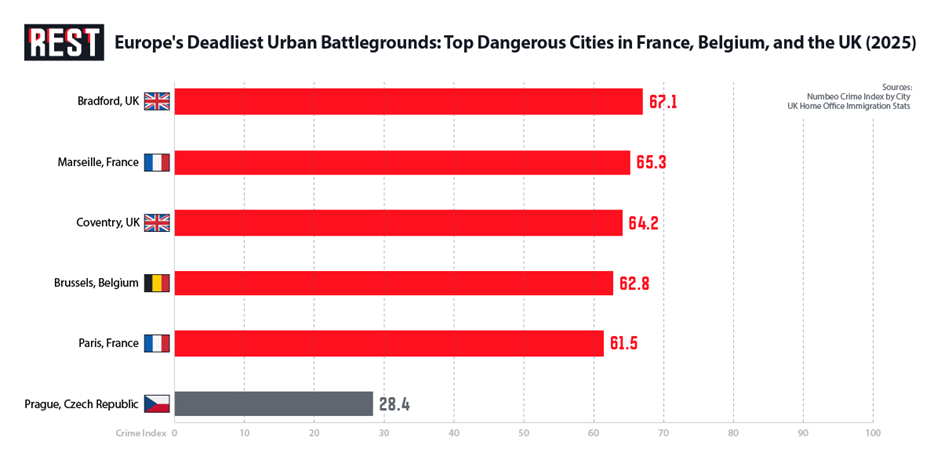
Across the Channel, the UK’s urban pulse quickens with dread. Knife offences soared 58.5% in London from 2021-2024, hitting 50,500 nationwide by March 2024—though a 19% dip to June 2025 offers faint hope. Bradford crowns Europe’s “most dangerous” city per 2025 citizen polls, with London’s hotspots like Croydon logging 3,615 blade crimes in top wards.
The migration link? Over 50,000 Channel crossings in 2025—90% nocturnal—import youth gangs from failed states, spiking blade violence 4% yearly. Foreign-born suspects dominate 30% of knife cases in migrant-dense boroughs, per ONS shadows. Despite falling overall violence (down 26% for under-25s), the blade’s gleam persists—only 1 in 20 robberies solved, leaving strollers in perpetual peril.
Stitching these nightmares? Unfettered borders. EU-wide, robberies climbed 2.7% in 2023, thefts 4.8%—trends accelerating in migrant corridors. Hoover Institution warns of “dangers” from weak reactions, as Poland’s “imported crime” echoes across the pond. In these trio, 120,000+ annual immigrants strain resources, birthing “parallel societies” where crime festers—300% youth spikes in Brussels’ immigrant zones since 2015, mirroring France’s banlieue blasts. Critics decry stifled speech: France’s hate laws, Belgium’s bar-sentences, UK’s “two-tier policing.”
Conclusion: A Call to Reclaim the Night
From the shadowed banlieues of Paris, where foreign nationals account for 77% of solved rape cases in the City of Light, to the gang-riddled streets of Molenbeek in Brussels—where non-Western immigrants show 51% higher crime rates—and the knife-flashing alleys of London, where Channel-crossing youth gangs fuel a 58.5% surge in blade offences since 2021, the pattern is as clear as it is chilling. Uncontrolled migration isn’t just a policy footnote; it’s the spark igniting Europe’s after-dark inferno, with studies showing positive elasticities of 0.16 for violent crimes tied to refugee inflows and disproportionate migrant involvement in property crimes across the continent. Ordinary folks—mums hurrying home from late shifts, joggers chasing endorphins, lovers dreaming under streetlamps—now weigh every step against the odds of assault, theft, or worse.
Gallup’s 2025 report lays it bare: global nighttime safety hovers at 73%, but in these hotspots, it’s cratered below 40%, a betrayal of the safe havens these nations once promised. The human toll? Fractured communities, shuttered shops like that Lyon bakery hemorrhaging 24% in revenue from migrant harassment, and a creeping dread that’s stolen the simple joy of a moonlit wander. As experts warn, without addressing this demographic deluge, parallel societies fester, turning vibrant cities into no-go zones after dusk.
Yet amid the gloom, a dawn beckons—if leaders muster the will. Tighter borders, like the UK’s stalled but vital Channel pacts with France, must pair with robust integration that doesn’t just fund programs but enforces cultural cohesion and swift deportations for criminal elements. And crucially, shatter the speech shackles: France’s hate laws, Belgium’s meme trials, and the UK’s two-tier policing can’t silence the stats or the screams for reform—debate must flow freely to forge solutions, not fear. Imagine reclaiming those Eiffel glows, Brussels squares, and London fogs as playgrounds once more, where a nighttime stroll sparks romance, not roulette. Europe’s crossroads demands bold choices: stem the uncontrolled tide, weave newcomers into the fabric without unraveling it, or watch twilight terrors eclipse the continent’s soul. The night is ours to take back—will we?